How to Treat the Exhaust Air from Poultry and Meat Processing Companies?
Industries like poultry and meat processing companies causes odour nuisance to the neighborhood. There have been several technologies to tackle this situation. The requirement of an exhaust air treatment system is determined on the basis of the size of the facility, the specific processing operations involved, the exhaust air volume, and pollutant load to be treated, and the resulting nuisance potential. Elixir enviro Systems Pvt Ltd (www.elixirenviro.in) is a pioneer in odour control. Elixir Enviro Systems Pvt Ltd designs the required upstream and downstream processes for the effective odour control strategy. The strategies include appropriate ventilation design and pretreatment steps for the optimal operation of the Odour Control Unit(OCU).
What kind of exhaust air treatment system should be used in a slaughterhouse? It could vary for different facilities and is purely decided on case-by-case basis. Here are the commonly used exhaust air treatment systems for slaughterhouses:
Biological exhaust air treatment
Biological elimination of pollutants from air is the most environmental-friendly technique since it ensures minimal use of chemical agents and in many cases, it comes as the lowest lifetime cost alternative compared with other treatment technologies. In biological exhaust air treatment, microorganisms are used to convert odour components to CO2 and H2O.
Bioscrubber
Bioscrubbers are also called Bio-washers. In the Bioscrubber, absorption of air pollutants and the reaction or degradation of the pollutants occurs in two reactors. In the first stage the air is being washed or gets in contact with the air having the pollutant load and the absorbent or the liquid absorbs the pollutant from the air. In the second stage, this absorbent is treated biologically and circulated back to the washing stage. If you look in general, the Bioscrubbers are mainly employed for highly soluble and low volatile compound treatment.
Bio-Trickling filter
The contaminated air is passed through the packing media made of inert materials. In these filters, a liquid phase is trickled into the media. The pre-humidification can be avoided in the bio-trickling filters as the water phase can provide the moisture for the biomass activity. In Bio-Trickling filters inert materials with chemical stability, low weight and good mechanical properties are preferred. These filters are well aerated systems and the microorganism responsible for the degradation are usually aerobic but deeper into the bed, there is also anaerobic degradation. The flip side of this process is the requirement of micro and macro-nutrient supplementation to assure that the microorganisms are getting enough nutrients for the growth. If this nutrient supplementation is not properly regulated, this can lead to clogging of the unit.
Biofilter
What is biofilter? It is basically a porous layer made up of organic material. It supports the microbial population. The odorous air is forced into the porous layer where the biological degradation takes place. Odor emission is controlled to over 95 percent with biofilters. It should be noted that media moisture content affects the functioning of biofilters. The biofiltration technology is an entrenched odour pollution control technology in various parts of the world.
Chemical Absorption
The solubility behaviour of contents determines the absorption of gas in liquid. In absorption too, the efficiency is determined by adjusting the pH to acidic or alkaline. Hence the absorbers function as chemical scrubbers.
Process combination
Rather than limiting to one technique, usage of a combination of techniques has proven to be more efficient in slaughterhouse facilities. For example, combination of chemical and biological processes is mostly practiced.
CONCLUSION
Odor emission is an important measure that should be taken by slaughterhouse or meat and poultry processing facilities for the well-being of humans and environment. Elixir Enviro Systems Pvt Ltd is a pioneer in the field of odour control from such industries. Different kinds of cost-effective and highly efficient odor control systems are designed and implemented by the company all over India.
An Insight into Odour Control in Reclaim Rubber Factory
ODOUR POLLUTION
Odour emission from industrial and commercial establishment invariably attracts adverse public attention. Regulatory agencies have closed down industries because of odour complaints. Odour also affects worker health and labour relations. Until the development of gas biofilters, odour control system was expensive and inefficient.
RUBBER RECLAIMING
Rubber reclaiming refers to the process of reclaiming rubber from scrap tyres. Tyres are ground to small particles and subjected to devulcanizing. After devulcanizing the rubber is soft and can be compounded with additives and rolled into sheets that can be used as a raw material in the manufacture of new tyres. Chemical reclaiming uses devulcanizing chemicals and high temperature and pressure (20-22 bar) to soften ground rubber. These chemicals are aromatic organic compounds. The reaction is carried out in autoclave as batches. At the end of the reaction, the devulcanized mash is discharged after autoclave pressure is released.
SOURCES OF ODOUR
The autoclave pressure release contains a large amount of volatile organic compounds. Many of these are sulphur containing organic compounds formed from devulcanizing of rubber, which is essentially breaking of sulphur cross-linkages in vulcanized rubber. If condensed, the condensates from autoclave steam release, is extremely foul smelling and hence is an effluent discharge issue. The soft rubber mash discharged from autoclave is hot and is a source of odourous vapours. Another source is the handling and working of rubber during maceration and sheeting.
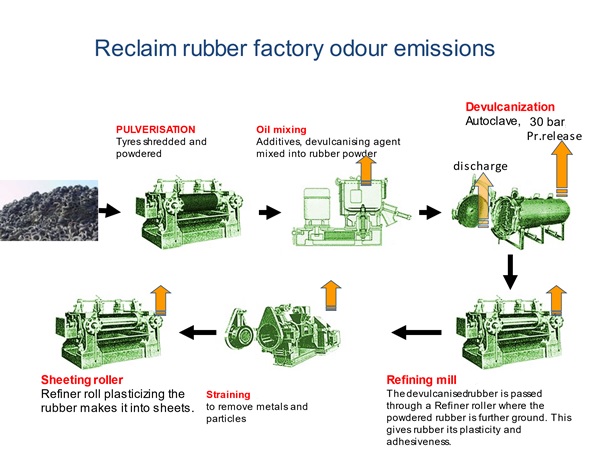
Figure 1: The orange upward arrow shows odour emission sources
ODOUR CONTROL
Hot autoclave release emissions are treated separately by direct incineration in the factory boiler. Scientifically calculated and automatically controlled release of vapour ensures complete combustion while boiler firebox temperatures are unaffected. The incineration system not only destroys odour but also eliminates effluent. The remaining low strength, low temperature vapour is better treated in the Biofiltration unit.
Biofiltration uses micro-organisms to remove undesirable components from industrial waste gases. Waste gases are forced through filter material on which micro-organisms are immobilised. After absorption in the filter material, micro-organisms break down the polluting components and transform them into harmless products such as carbon dioxide, mineral salts or acids and water. Biological waste air treatment processes offer a cost-effective solution for the treatment of large volumetric airstreams containing low levels of pollutants. They have found use in a broad spectrum of industries. Biofiltration is distinguished by its low operating costs, low maintenance requirements and low energy requirements. Properly designed biofilter achieve very high odorant removal efficiency (>99%).
Biofilters can be designed as low-cost open systems with single stage media. Where land is not available, biofilters can be provided as multi-storey units. Biofilters can also be located on roof of factory buildings to have maximum space savings.
ELIXIR BIOFILTER TECHNOLOGY
EES undertakes careful study of customer requirements before design of the odour control system. The most important step in the design of a successful odour control system is that characterisation and estimation of quantity of odour emissions. In most cases, direct measurement of quantity of emissions is impossible. It requires considerable skill and creativity to make reasonable estimates required for design.
Pre-treatment requirements and media composition have to be selected to suit the emission characteristics. Hot gases have to be cooled and humidified before biofiltration. Elixir Enviro Systems Pvt Ltd (www.elixirenviro.in) designs the ventilation system required to collect odour from open spaces like dumps or sumps and closed spaces such as sheds. Gas biofilter are best suited for emissions with low VOC concentration. For high strength emissions such as pressure reactor release, EES designs incineration system for odour control.
EES is biofilter media is advanced proprietary development originally based on license from the patented biofilter media of CSIR-NIIST. The media marketed by EES is known for its high-performance, low-cost BIOFILTER MEDIA. It features
Guaranteed performance and life
very low pressure drop,
Plug and play start-up to maximum activity,
high water holding capacity
green eco-friendly material
This biofilter media has the ability to accommodate highly varying “puff” loads which is a common occurrence from may industrial sources.
Bacteria are at the heart of a successful biofilter and a key factor is the growth of suitable microbial population. EES (www.elixirenviro) brings experience of Odour Control system in different fields and internationally recognized competence in biological treatment systems to guarantee biofilter performance.
Things You Need to Know about Odour Control Systems Today
Air- without it, life is over in seconds. Air is the most consumed gift of nature by humans. Yet we pay too little attention to managing air pollution.
Odour is a serious inconvenience for humans and brings about great irritation and physical stress to our day to day lives. The air we breathe in, the water we drink should be odourless and tasteless. The presence of foul odour indicates something toxic. The right to clean odour free air is part of the fundamental right to life. Industries, commercial establishments, municipalities and housing establishments have a legal responsibility to ensure that their activities don’t cause odour pollution and have proper Odour control systems.
SOURCES
The common sources of odour are:
- Food and Feed processing industries such as fish canning/processing, spice processing units and spice warehouses, bakeries, coffee grinding units, edible oil processing units, Shrimp-fish-pet feed industries, Slaughterhouses
- Chemical & Petrochemical industries including Extraction units – both colour and flavour, Latex and Rubber processing units, petroleum refineries, waste oil refining units, Bitumen hot mix plants, Pulp and Paper mills, printing houses, fiber glass units
- Petrol pumps
- Pharmaceutical and drug manufacturing units
- Fish and meat markets, commercial kitchens
- Reprocessing units such as Reclaim rubber units, Waste paper/carton reprocessing unit, plastic waste reprocessing units
- By-product’s processing units such as Bone Meal, Fish meal, Chicken feather meal, Slaughterhouse waste rendering
- Sewage pumping stations, sewage treatment plants
- Solid Waste transfer and treatment facilities
- Chicken farms, pig farming, cattle sheds
Since odour affects us and our fellow beings physically and mentally especially when exposed to it frequently or persistently, it is a growing concern at a humanitarian level, Hence the need of Odour control systems. This is why few skilled individuals devoted their time to find a solution for this inconvenience. Companies like Elixir Enviro Systems provide industries with technology to be environment friendly.
Why is it essential to have an odour control system in your industry?
1. To eliminate harmful health risks
Odour control systems are set up for welfare of the employees and those who live in the neighbourhood. Odour can cause vomiting, nausea, headache and mental fatigue which will interfere with their day to day lives. We are liable to keep the impacts of our operations from harming others.
2. Control Air Pollution
It is popular knowledge that industries are the biggest contributors to air pollution. Children are cursing industries for taking away the quality of our environment and leaving them with no good air to breathe. Odour control systems remove odour due to harmful gases from the air. It’s high time industries act with responsibility.
3. Free of Complaints
Irritation caused due to odour can lead the nearby residents to file a complaint against your industries to the concerned officials. If the complaint is valid, you would be facing legal cases. Save yourself from such chaos by investing in an efficient odour control system.
How to control odour?
Odour emitted from industries contains complexes chemical compositions. The first and foremost thing about odour control is the effective capture of the odour from the factory. To capture the odour, a proper exhaust ventilation system has to be designed. Once the odour is collected, the next thing is the selection and careful implementation of the suitable odour control system. A wide range of odour abatement technologies is available including Biofilters, Bioscrubbers, physical adsorption, Chemical scrubbing and catalytic/thermal oxidation systems. Spraying “deodarants” are wrong practice and do not control or eliminate the odour from the exhaust gas. The choice of the treatment to be used depends on many factors including required odour removal efficiencies, flow rate & inlet odour concentration, type of chemical species in the odour, variability in flow and load, space requirements and infrastructure (power, drainage, etc). Biofilter is considered to be an ecofriendly and cost-effective technology to eliminate the volatile organic compounds (VOCs), H2S, Ammonia and other odorous gases from the exhaust gas stream.
CONCLUSION
Be a part of the movement to shift our industrial activities from non-ecological to environment friendly. Elixir Enviro Systems provide you with scientifically engineered technology-based Odour control systems to beat odour related issues.