
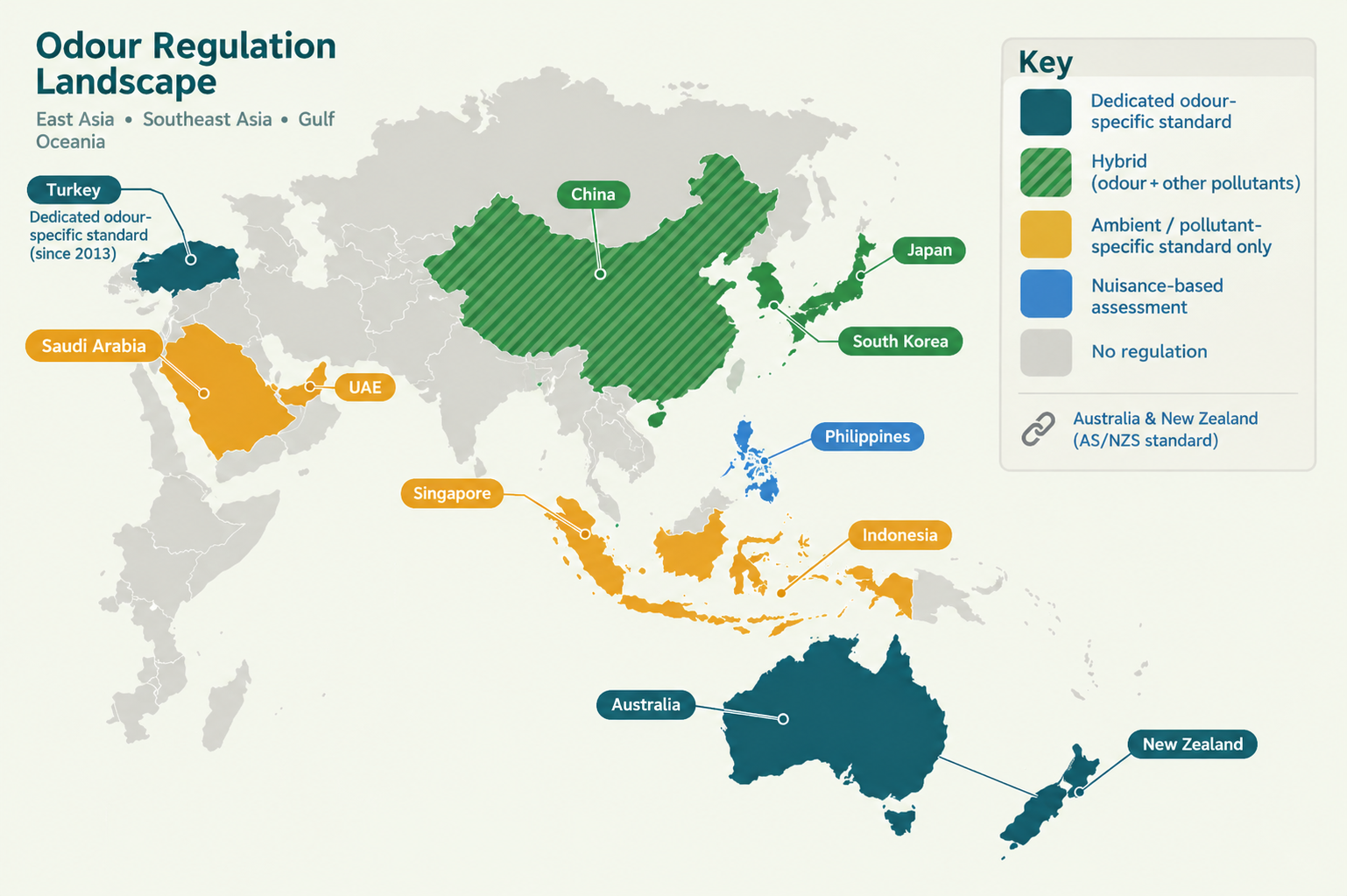
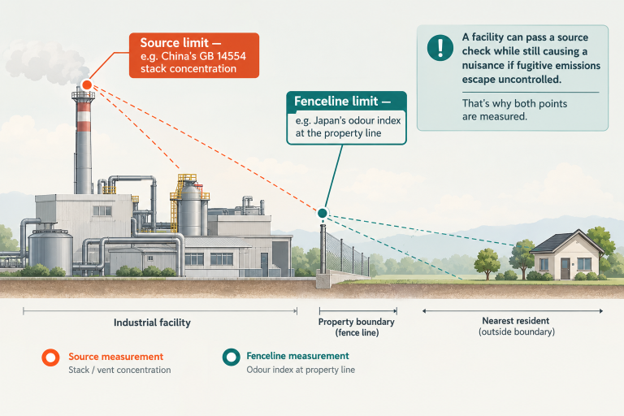
A plant can pass every stack test it is given and still be the reason a neighbourhood keeps its windows shut. That gap — between what is measured and what is smelled — is where odour regulation is decided, and the Asia-Pacific region has answered it three different ways. Europe, North America and Australia make the receptor the primary compliance test: they measure how much smell reaches a person, wherever it came from. That approach breaks down fast in East Asia’s densest industrial zones. China, Japan and South Korea put the compliance test on the stack and the fenceline themselves, so that fugitive (uncontained) releases and stack discharges are each held to a number of their own. When millions of people live within smelling distance of an industrial zone, tracing a nuisance back from a window to a valve is impractical; regulating both ends of the pipe is not. This post covers that East Asian model, the very different approaches across Southeast Asia, the Gulf and Oceania, and what each means for a plant that has to comply — before the final two posts turn to a global comparison and to India, which currently has none of these systems in place.
One thing stands out immediately on moving from the Americas to Asia: how much more government-led enforcement looks here, compared with the complaint-driven model that dominates North America. South Korea’s proactive annual inspections, Japan’s decades of steadily tightening odour index regulation, and China’s detailed laboratory-construction requirements all reflect a regulatory culture built around routine government inspection rather than waiting for citizens to complain. That’s partly a function of population density — with so many people living close to industrial zones, a purely reactive system risks being overwhelmed — and partly of how much these countries have been willing to fund proactive monitoring infrastructure.
The sequence that produced South Korea’s current system is unusual among the countries in this series. Odour control started life as a minor sub-clause within general air-pollution law, and stayed that way for years even as complaints mounted — the country’s aggressive late-1990s inspection campaign actually predates the dedicated odour law by several years. Only once it became clear that general pollution law was too blunt for the local, facility-level nature of odour complaints did the government carve odour out into its own law: the Malodor Prevention Act of February 2004, in force from February 2005. That sequencing — build enforcement muscle first, formalise the dedicated law once the gap becomes undeniable — suggests a country doesn’t need a complete legal framework before it can start enforcing anything at all.
South Korea
Regulatory mechanism: hybrid — dedicated Malodor Prevention Act (2004), enforced through 22 designated substances plus a sensory dilution limit.
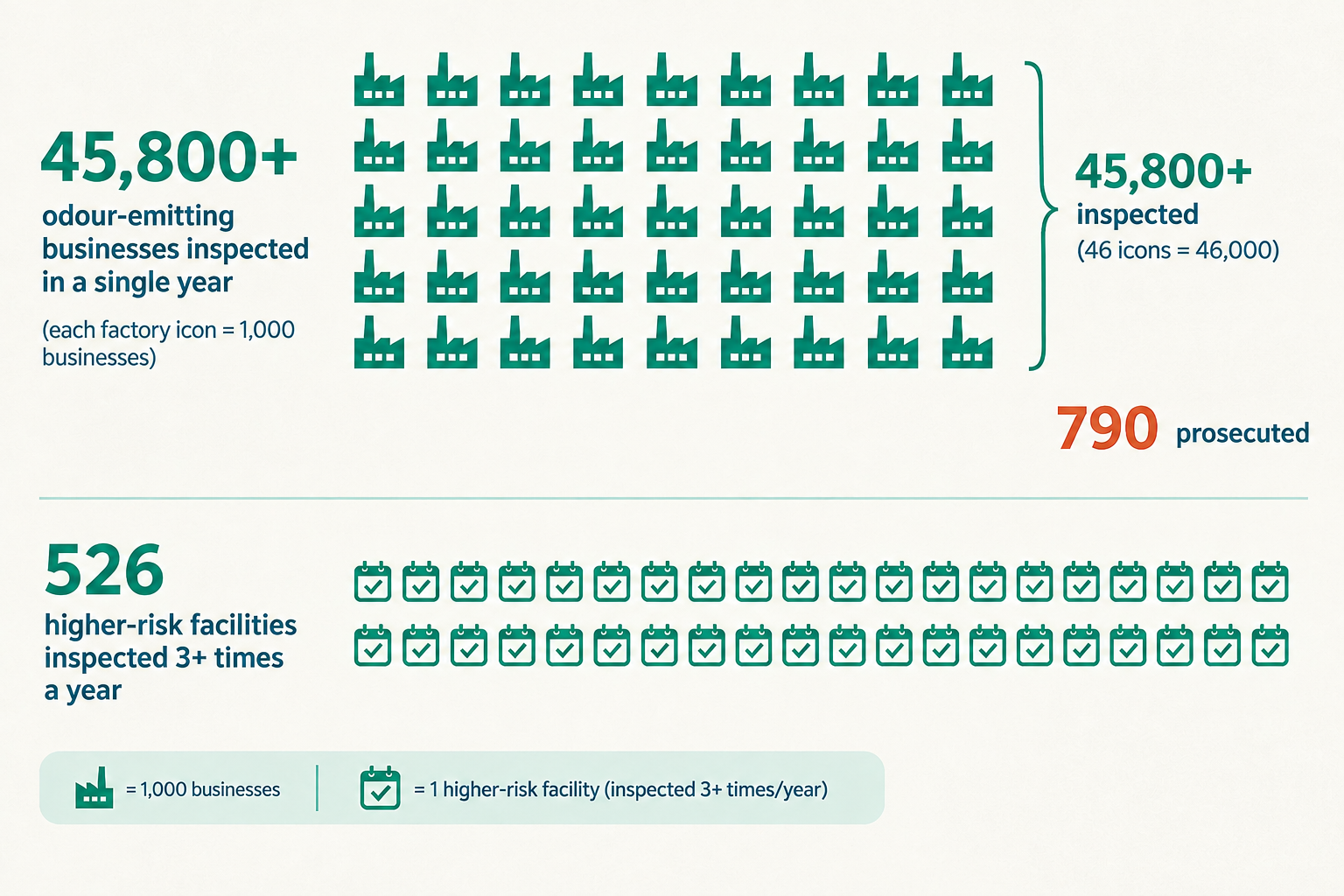
South Korea enforces one of the strictest odour control systems in the world, and it built the inspection culture before the law. In 1999 alone, the Ministry of Environment inspected some 45,800 odour-emitting businesses, prosecuted 790 of them and imposed administrative measures ranging from mandatory upgrades to suspensions and fines; by the early 2000s, 526 companies were under stricter monitoring, inspected at least three times a year, while the Ministry provided technical help to smaller businesses and kept a continuously updated database of odour sources (Park Sang Jin, Woosong University, MOE Japan odour workshop proceedings, c. 2003).
The 2004 Act, in force from 2005, rests on seven pillars: local (not national) authorities lead enforcement, since odour impact is inherently local; persistent problem areas are designated as malodour control areas, which triggers tighter limits; permitted release levels can be tightened further locally if complaints persist; rules apply to processing and storage, not just smokestacks; larger facilities must publish their own odour-prevention plans; designated inspection agencies carry out the compliance measurements; and local governments report regularly to the Ministry on both complaints and inspection findings. On the technical side, Korea sets numeric ceilings by method. Compound odour is measured by air-dilution olfactometry: at the site boundary it may not exceed 20 dilutions in industrial areas (15 elsewhere), and at stack outlets 1,000 (500 elsewhere); inside a designated malodour control area a local government can tighten those to 15 and 10. Chemical analysis caps ammonia at 2 ppm in industrial areas (1 ppm elsewhere), hydrogen sulphide at 0.06 ppm (0.02 ppm elsewhere) and methyl mercaptan at 0.004 ppm (0.002 ppm elsewhere), with the designated-substance list expanded from 8 to 22 over 2005–2010.
China’s approach is worth unpacking because it’s one of the few systems in this series that treated source control and fenceline control as equally important from day one, rather than adding one later. GB 14554-93 — approved in 1993 and still the current, unrevised rule — doesn’t just set a stack discharge limit; the same standard also sets a factory-boundary concentration limit specifically for fugitive (uncontained) releases, like an open storage yard or a leaking valve. That dual coverage matters in exactly the kind of dense, mixed industrial-residential geography this series keeps returning to: a stack-only standard can be fully complied with while a facility still causes a serious nuisance through uncontrolled fugitive emissions — a common real-world failure mode wherever regulation focuses only on the easiest thing to measure. China proposed tightening these thresholds in a 2018–19 draft revision, and by early 2026 that revision had reached final approval draft at the Ministry of Ecology and Environment — abolishing the three-tier zone system, tightening limits and changing the stack-height bands. Until it is promulgated, the 1993 numbers remain the law, but a plant in China should be planning for the tighter, untiered limits, and in Shanghai, Tianjin or Shenzhen it is already working to stricter local standards.
China
Regulatory mechanism: hybrid — dedicated national odour standard (GB 14554), implemented via limits on eight named odorants.
China’s national odour standard, GB 14554-93, dates to 1993 and remains the current rule: the national standards register still lists it as in force, with its replacement at the drafting stage. It sets stack discharge limits for eight specific odorants and for overall odour concentration, scaled to stack height, and separate fenceline limits for fugitive emissions in three tiers tied to the surrounding land-use class. It applies to any business releasing offensive gas, and to environmental impact assessment, design review and post-construction inspection. The measurement side has moved far faster than the limits. HJ 905-2017 sets out how odour monitoring is done — site selection, sampling frequency, data handling and quality control — and its companion HJ 865-2017 specifies how an olfactory laboratory must be built and run, down to separate sample-preparation, sample-mixing and evaluation rooms and a ceiling on the lab’s own background odour. The triangle odour bag method was re-issued as HJ 1262-2022 (in force January 2023); a dynamic-dilution olfactometry method (HJ 1416-2025) now sits alongside it; and from 1 August 2026 HJ 1444-2026 replaces the 1993 sulphur-compound method, expanding coverage from four to ten sulphur odorants with detection limits down to 0.09 µg/m³. The limits are thirty years old; the labs enforcing them are not.
Japan
Regulatory mechanism: hybrid — dedicated Offensive Odour Control Law, implemented via a 22-named-compound list (ammonia, hydrogen sulphide, styrene, xylene, etc.) or, since 1995, a composite odour index.
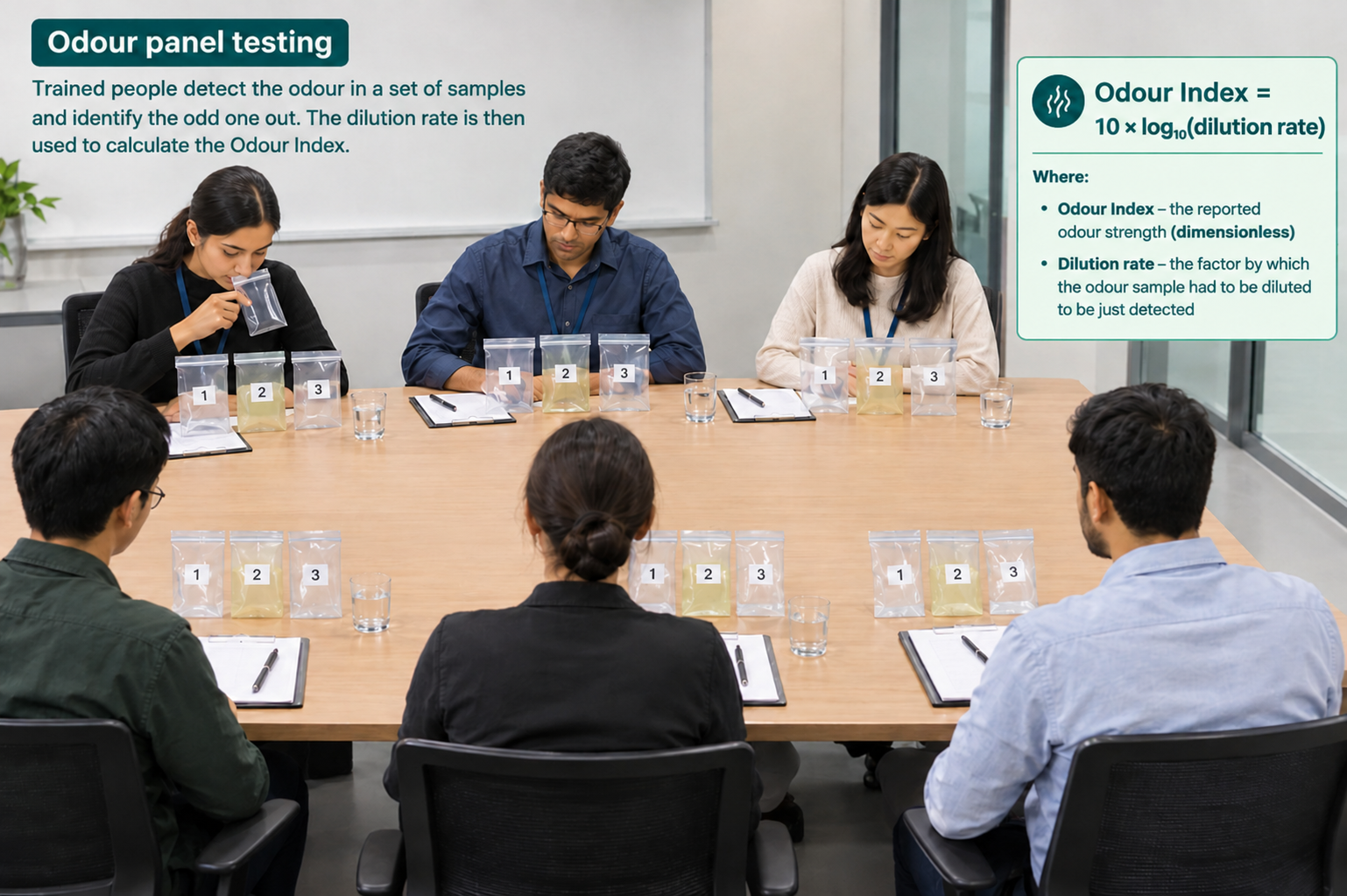
Japan’s Offensive Odour Control Law (OOCL), passed in 1971 and in force from 1972, was a direct response to a wave of complaints during the country’s rapid post-war industrialisation — complaints that fell steadily through the 1980s as factory odour was brought under control, then climbed to a record 24,587 in 2003 as the mix shifted to open burning (44% of that year’s total), restaurants and other service premises — a pattern worth noting for any city expecting a dedicated law to settle the problem. The law bites only inside areas designated by the prefectural governor, which now cover most urban municipalities; outside them there is no legal limit. A 1995 amendment let municipalities opt for a composite “odour index” instead of regulating individual substances — calculated as 10 × log₁₀(dilution rate), with site-boundary values set by each local government between index 10 and 21 — the band the law equates to a weak but clearly perceptible smell — using the “Triangular Odour Bag Method,” where a panel of six or more assessors repeatedly tries to pick out a diluted sample from two blanks until they can no longer tell the difference. The law covers three distinct release points — stack/vent emissions, site-boundary odour, and wastewater odour — each with its own formula. Beyond the national law, more than thirty Japanese municipalities have added their own stricter local rules or voluntary agreements with nearby factories, and several cities now publish live on-site inspection results online.
Singapore
Regulatory mechanism: ambient air quality standard plus planning buffers and nuisance powers; no odour-specific law.
Singapore’s environmental transformation — from a newly independent country in 1965 struggling with polluted rivers and sewerage covering only part of the island, to one of the most environmentally organised cities in the world — is a genuinely impressive case study. Still, it’s worth being clear-eyed that very little of it is odour-specific regulation. The Environmental Protection and Management Act (the renamed Environmental Pollution Control Act) bundles water, noise, air and hazardous-materials rules under the National Environment Agency, and the country tracks general air quality through a US EPA-style Pollutant Standards Index with long-term targets benchmarked to WHO guidelines. Odour itself is handled indirectly: buffer distances for odorous industries in NEA’s Code of Practice on Pollution Control, and nuisance provisions under the Environmental Public Health Act. Singapore is a strong example of comprehensive environmental governance; it isn’t, on the evidence available, a model for odour regulation specifically.
It’s tempting to hold Singapore up as a general odour-regulation success story, and this series wants to avoid overstating that claim. Singapore’s real achievement is a comprehensive, well-funded environmental governance system covering water, air, noise and hazardous materials together. But when it comes to looking specifically for rules targeting particular odours, there is much less to be found than the country’s good environmental reputation would suggest. The lesson to be learned from Singapore is not so much a specific standard of smell to be followed, but the fact that the country is willing to fund an empowered central environmental agency and to use a combination of legal, administrative and public-education measures rather than just legislation.
The Gulf and Turkey
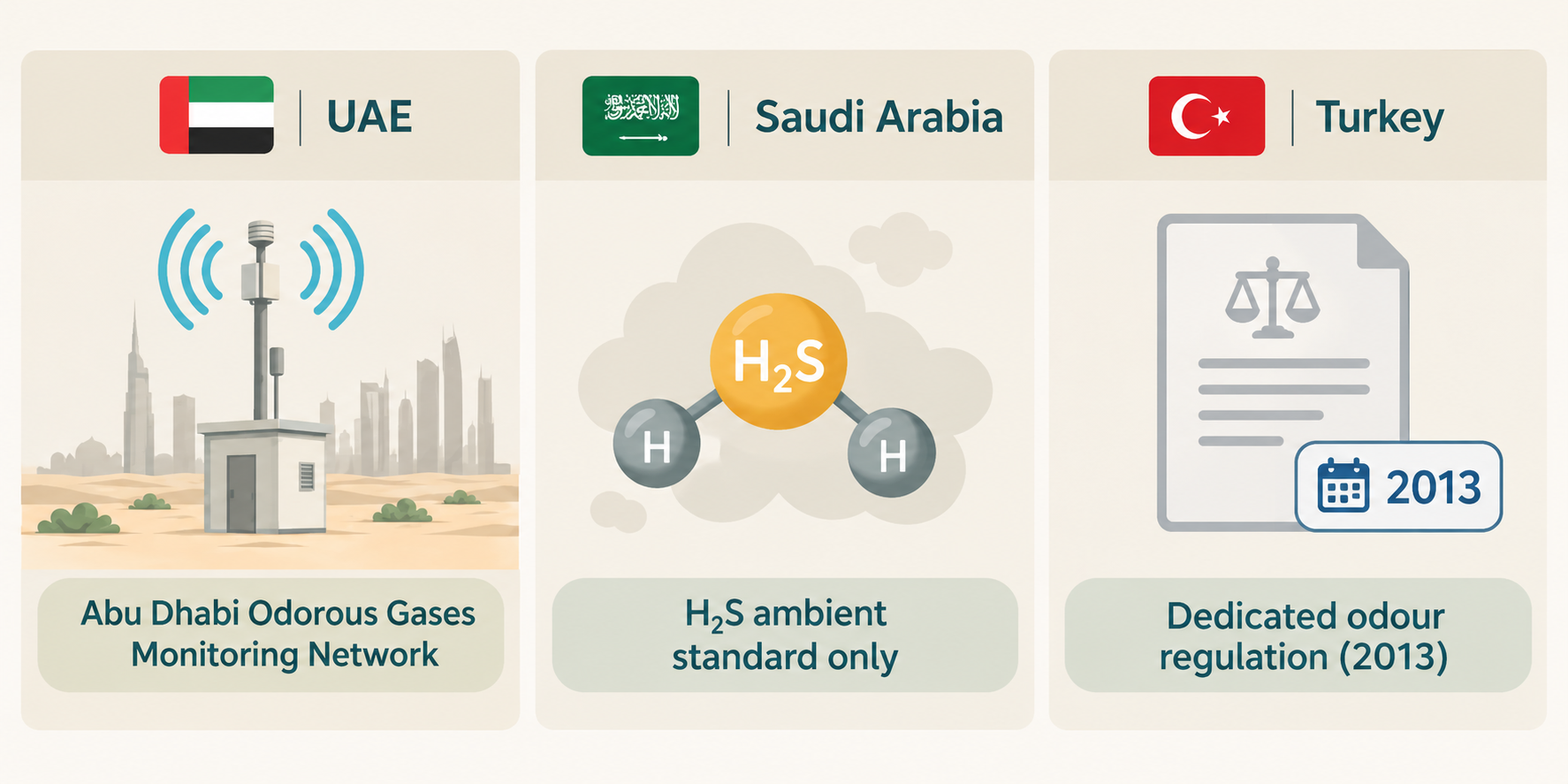
Regulatory mechanism: UAE — ambient air quality standard-based (no numeric odour law). Saudi Arabia — ambient standard for hydrogen sulphide (no odour law). Turkey — dedicated odour regulation (2013) using olfactometry and receptor-based assessment.
The UAE has built odour-relevant infrastructure without an odour standard. In February 2024, the Environment Agency – Abu Dhabi launched the Abu Dhabi Odorous Gases Monitoring Network — fifty fixed sensors across the emirate, starting with the Mafraq industrial area and nearby residential districts, plus two mobile reference stations — to detect and trace odorous releases, and federal ambient limits cover hydrogen sulphide. No numeric odour limit yet applies to a plant, but the same programme is tasked with drafting one and with setting up an accredited olfactometry laboratory, so that gap is closing.
Saudi Arabia’s National Center for Environmental Compliance regulates ambient hydrogen sulphide levels (since H₂S is a recognised odorant) and sets stack emission limits for specific pollutants from stationary sources, mainly aimed at the energy and petrochemical sectors, plus a general nuisance clause requiring operators to avoid emissions that are “injurious” or cause a public nuisance — but there is no odour standard as such.
Turkey is the exception in this group. Its Regulation on the Control of Odour-Forming Emissions (2013) assesses odour at receptors using olfactometry and dispersion modelling, with different allowances for residential and industrial land. It is the closest thing in this post to the European receptor model, and the clearest sign of where EU alignment pulls a candidate country.
Indonesia
Regulatory mechanism: ambient/pollutant-specific standard — no dedicated odour law. Controlled via Ministerial Decree 50/1996 limits on ammonia, methyl mercaptan, hydrogen sulphide and other named substances.
Indonesia’s 2009 Environmental Protection and Management Law (replacing a 1997 predecessor) is the parent law supported by the constitutional right to a clean and healthy environment. Air, water, soil, and hazardous waste are broadly defined to include odour and environmental assessment; it has real, dissuasive consequences for those breaking the law and leaves the detail to ministerial regulations. An Odour section, Ministerial Decree No. 50/1996, establishes Offensive Odour Level Standards for named odorous substances: ammonia 2.0 ppm (indophenol spectrophotometry), hydrogen sulphide 0.02 ppm (methylene blue spectrophotometry or GC), methyl mercaptan 0.002 ppm (GC), plus methyl sulphide 0.01 ppm and styrene 0.1 ppm.
It’s worth flagging just how strict some of Indonesia’s 1996 thresholds look on paper — methyl mercaptan at 0.002 ppm reflects how potent that compound’s smell is even in trace amounts (mercaptans are, not coincidentally, the class of chemical deliberately added to otherwise odourless natural gas so leaks can be detected by smell), and verifying it needs pre-concentration gas chromatography: routine for a modern laboratory, out of reach for many provincial ones. The gap between a genuinely low legal threshold and the practical difficulty of reliably measuring compliance with it at that concentration is a recurring theme worth remembering: a strict number on paper is only as good as the laboratory capacity available to actually verify it, a point this series returns to directly in its final post.
Philippines
Regulatory mechanism: ambient/nuisance-based — the Clean Air Act prohibits emissions constituting a “nuisance” and requires odour-control equipment, but sets no numeric odour standard.
The Philippines has established air quality standards under the Clean Air Act of 1999 (Republic Act 8749) administered by the Department of Environment and Natural Resources – rules published in 2000. This prevention-oriented law applies to all mobile, stationary, and area sources – with established national ambient air quality standards for some pollutants – and powerful financial incentives: daily fines for stationary sources breaching emission standards, paid to a specific Pollution Adjudication Board, scaled to the polluter’s capacity to pay, wilfulness, and compliance history. On odour specifically, though, the Act works the way many general air laws in this series do: through a broad nuisance prohibition (no person may discharge air contaminants “which constitute nuisance”) plus equipment-design requirements — re-heating furnaces, bake ovens, coffee heaters, paint booths and similar sources must be designed so that no objectionable gases flow freely into the atmosphere, with appropriate pollution-control facilities installed to minimise the escape of smoke, odours, fly ash or fumes. There is no numeric odour standard, no odour-unit metric, and no dedicated odour law — which places the Philippines alongside Singapore and Indonesia in the region’s “general framework, odour handled indirectly” group, though notably with a stronger, better-defined penalty and adjudication system behind it than most.
Australia
Regulatory mechanism: dedicated odour-specific standard, but state-administered — no single national odour law.
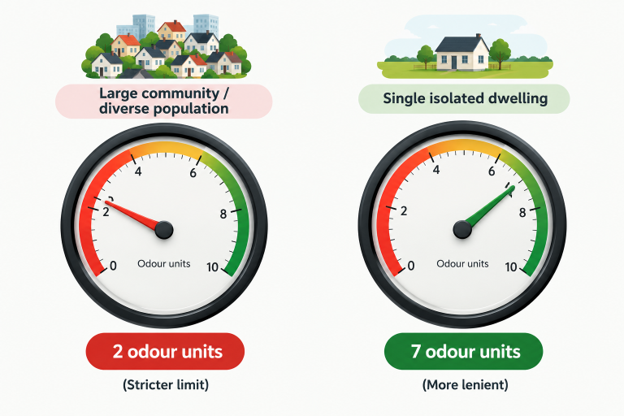
Australia doesn’t regulate odour as a single national scheme; each state runs its own regime under its own environment protection legislation — New South Wales, for instance, through the Protection of the Environment Operations Act 1997 — while all states measure odour the same way, using the joint Australian/New Zealand standard AS/NZS 4323.3 for dynamic olfactometry. Dispersion-model outputs (in odour units per m³) are compared against each state’s own guideline values to judge whether an “offensive” impact is likely. The statutes differ and so do the impact criteria; the underlying logic doesn’t — and in New South Wales it is sensibly scaled to how many people are affected. NSW sets a 2 OU/m³ criterion (99th percentile, nose-response-time averaging of about one second) for communities of 2,000 or more, rising in steps to 7 OU/m³ for a single rural residence, on the reasoning that a larger, more olfactorily diverse population is more likely to include highly sensitive individuals. Victoria has moved the other way: since its Environment Protection Act 2017 came into force in 2021, odour is assessed as a risk under the general environmental duty (EPA Publication 1883, 2022) rather than against a single design number. Modelling decides whether a plant gets licensed; once it is operating, the offence of emitting “offensive odour” beyond the boundary (POEO Act s.129 in NSW) is what inspectors actually enforce, on observation rather than on a model.
New Zealand
Regulatory mechanism: dedicated odour-specific standard (odour units, Resource Management Act guidance).
New Zealand’s Resource Management Act 1991 governs odour, with the Ministry for the Environment’s Good Practice Guide (2016 edition) applying the same dispersion-modelling-against-guideline-values logic as Australia, expressed in odour units per m³. New Zealand’s guidance adds a peak-to-mean ratio to the assessment (comparing short spikes to average concentration) and applies a percentile threshold that depends on context. Notably, what varies the limit is the sensitivity of the receiving environment rather than the type of activity. The Ministry’s guideline values run from 1 OU/m³ in high-sensitivity areas such as housing and schools (2 OU/m³ where a source’s worst impacts come in calm, stable weather rather than turbulent daytime conditions), through 5 OU/m³ in moderately sensitive areas, to 5–10 OU/m³ on rural and industrial land, assessed as 1-hour averages at the 99.5th percentile, with the 99.9th used as a cross-check. A farm and a factory in the same zone are held to the same number; the legal test either must pass is whether the odour is “offensive or objectionable” at the receptor.
Put together, Asia-Pacific shows three distinct philosophies operating side by side: East Asia’s dual source-and-fenceline limits (China, Japan, Korea); the receptor model, scaled to population in New South Wales, to receptor sensitivity in New Zealand, and applied in European form in Turkey; and a group of fast-growing economies — the UAE, Saudi Arabia, the Philippines, and to a lesser extent Indonesia — still relying on general nuisance clauses and ambient/pollutant-specific standards rather than a dedicated odour metric.
It’s worth noting how differently each of the three East Asian systems arrived at broadly similar destinations. Japan built its system gradually, starting from a 1971 law targeting named compounds and only adding the more flexible odour-index option in 1995 once the basic infrastructure and complaint data existed to support it. China moved faster on paper — issuing a comprehensive national standard in 1993 — but the monitoring and laboratory-practice standards needed to enforce it consistently (HJ 865-2017 and HJ 905-2017) only arrived in 2017, and its sensory and sulphur-compound methods were only brought up to date in 2022–2026. South Korea, meanwhile, built enforcement capacity first (its aggressive 1990s inspection regime) and only afterwards carved odour out into its own dedicated law in 2004 (in force 2005). There’s no single right order of operations — legislate first and build capacity later, or build capacity and inspection culture first and formalise the law afterwards — but all three show that a credible odour-regulation system in a densely populated country has taken on the order of twenty to thirty years to mature fully, even for economies with substantial regulatory and technical resources to draw on.
The receptor logic also explains why Australia and New Zealand, despite sharing a joint olfactometry standard (AS/NZS 4323.3), calibrate their thresholds so differently by context — a single rural dwelling in New South Wales is allowed three and a half times the odour concentration tolerated near a larger town, and rural land in New Zealand five to ten times that of a school or home. That’s a deliberate acknowledgement that nuisance is partly a function of who is exposed and how varied their sensitivity is, not just how strong the smell is in absolute terms — a nuance that a flat national number, of the kind several countries in this series still rely on, can’t capture.
The next post pulls all of this — plus Africa and Europe, covered in Part 2 — together into a single global comparison of how different countries actually measure odour, before the final post asks what it all means for a country, India, that currently has none of these systems in place.
If this post leaves you with one takeaway, make it the East Asian one: in dense, mixed-use cities, measuring odour only at the receptor — waiting for it to reach someone before acting — is structurally too late. China, Japan and South Korea all concluded, independently, that the source and the fenceline have to carry limits of their own. That insight becomes central when this series reaches India, whose urban geography looks far more like Seoul’s or Guangzhou’s than like rural New South Wales.
Part 5 is the India roadmap this whole series has been building toward, and it borrows most from the three countries in this post. Subscribe, and it lands in your inbox the morning it goes live.
If your plant sits anywhere in Asia-Pacific, forward this to whoever signs your stack test: whether your jurisdiction tests at the stack, the fence or the window changes what “passed” means.