Every municipal sewage treatment plant (STP) smells bad. As soon as sewage enters the inlet works, biological and chemical reactions start to release hydrogen sulphide (H₂S), ammonia, mercaptans, and a variety of volatile organic compounds. If they are left uncontrolled, they cause people to complain, corrode electrical and instrumentation equipment, and pose a real threat to plant workers. The conventional engineering answer is to put walls around the smelly things, capture the stink, and treat it in a biofilter, bioscrubber, or chemical scrubber before discharging the cleaned air to the atmosphere.
But an odour control system is only as good as the airflow it is designed around. Capture too little air, and foul gases leak out of every cover joint and hatch into the surrounding neighbourhood. Capture far too much, and the municipality pays for an oversized fan, oversized ducting and an oversized treatment unit — then keeps paying, every month, in electricity and media replacement. The number that sits at the centre of this balance is the air change rate, or ACH (air changes per hour). This guide explains, in practical terms, how to arrive at the best ACH for a municipal STP, and — critically — how that rate must change depending on whether or not people physically enter the enclosed space.
The Air Change Rate is a very simple concept; however, it can be misunderstood as such. It refers to the number of times that all of the interior air of a confined space is removed and replaced by clean fresh air within a given time frame (i.e., one hour). If you are designing an enclosure with a 12 ACH rating, then you will remove and replace all of the air contained within your enclosure 12 times each hour. In odour control, the Air Change Rate bridges between two different types of quantities: a fixed geometrical quantity (air volume of a tank or a building), and an operational quantity that varies (i.e., airflow in m³/h that must be handled by the fan and/or the treatment unit). The relationship is quite simply stated: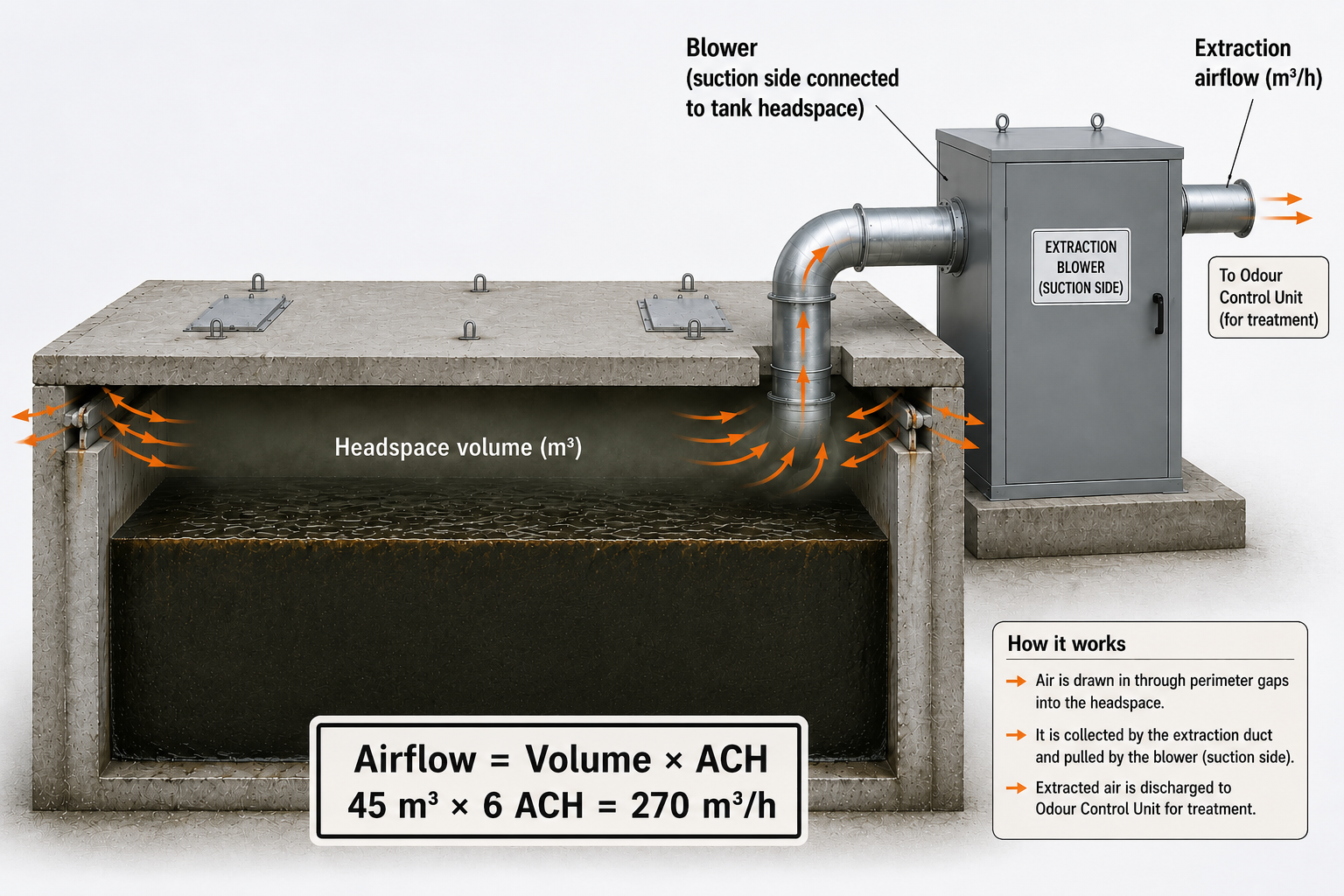
THE CORE DESIGN EQUATION
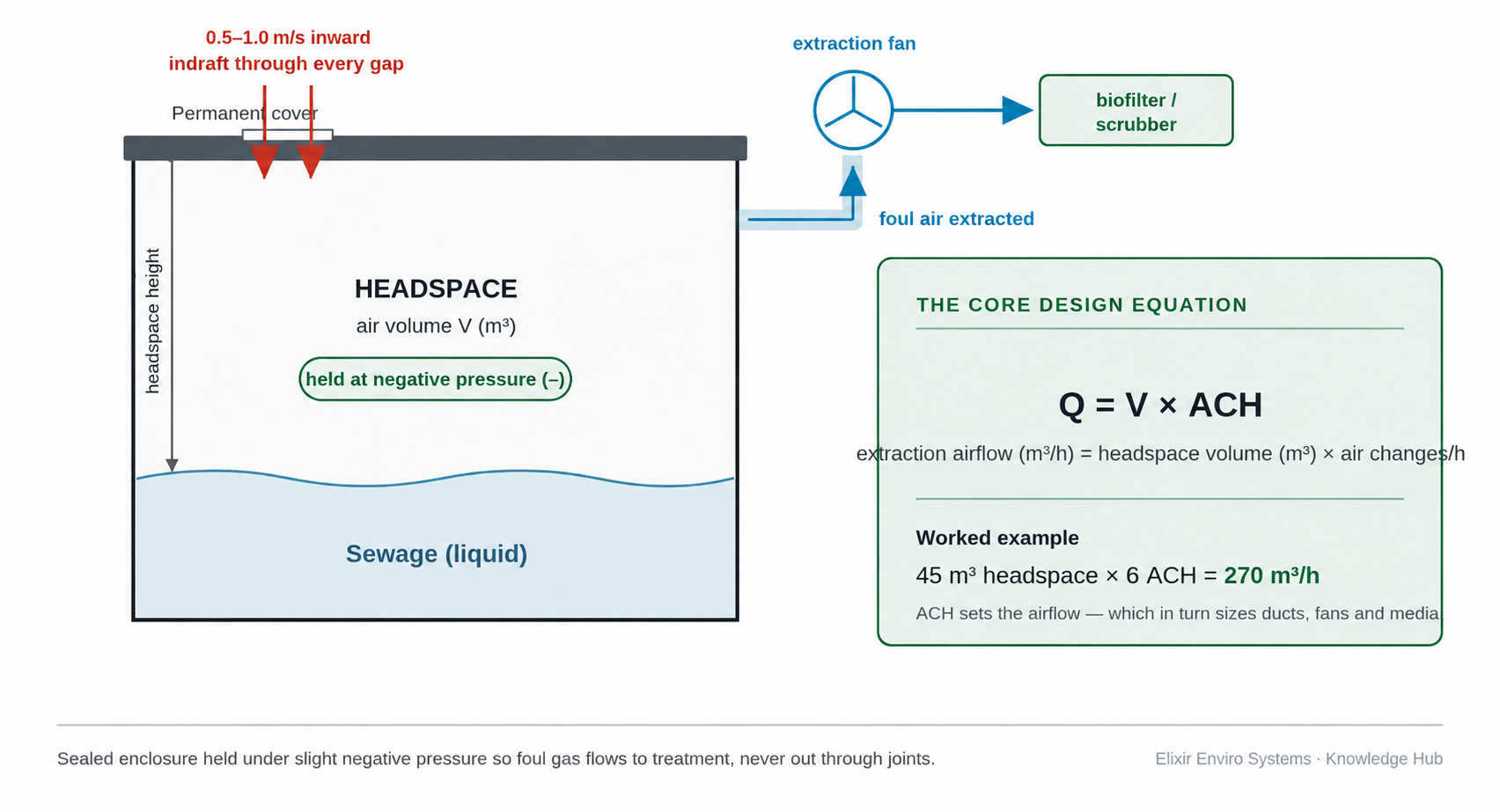
Extraction Airflow (m³/h) = Enclosed Air Volume (m³) × Air Change Rate (ACH)
Example: a covered inlet channel with 45 m³ of headspace, designed at 6 ACH, requires an extraction airflow of 45 × 6 = 270 m³/h
Because ACH directly drives airflow, it determines nearly every downstream decision: pipe diameters, fans’ duty points & motors’ sizes, treatment units’ surface areas & media volumes, physical footprints of sites that are land-constrained, and, finally, both capital and long-term operating costs. Therefore, choosing the correct ACH level is not just a detail — it sets the scale of the entire extraction system. It is not the only governing number, though: containment ultimately depends on the draft velocity through openings, and the treatment unit depends on the captured mass load and residence time. ACH is where the design starts, and it must be reconciled with both of those before it is finished.
A common and costly mistake in municipal tenders is to specify one blanket air change rate for the entire plant — “design all odour enclosures at 12 ACH,” for instance. In reality, the correct ACH for any given space depends on several interacting factors, and a good designer evaluates each enclosure on its own merits.
2.1 The strength and rate of odour emission
Different parts of an STP emit foul gases at very different rates. The inlet works, screen chambers and grit channels handle fresh, septic, turbulent sewage and are typically the strongest H₂S sources on the site. Sludge thickeners, holding tanks and dewatering areas carry a concentrated organic load and are usually the second-worst zone. By contrast, aeration tanks emit comparatively little odour because the process is aerobic, though fine-bubble aeration can still strip volatile organics, so ‘low odour’ does not always mean ‘no emission. The higher the emission rate from the liquid surface, the harder the enclosure must work to stay under stable negative pressure — foul gas is being generated faster, so more extraction is needed to keep air flowing inward through every joint and to absorb short-term surges in gas release. That is why high-emission structures justify a higher ACH. Note that the goal is containment, not dilution: for a sealed capture enclosure, the captured air can remain concentrated, which is in fact cheaper to treat, since biofilters and scrubbers are sized on mass load and residence time rather than on air volume.
2.2 Turbulence and the liquid surface condition
Odour emissions are based on how fast the sulphur (in the form of hydrogen sulphide) transfers from liquid to gas through turbulent agitation. Any place in a wastewater treatment system that has turbulence, such as cascading water (e.g., weirs), churning water (e.g., drop structures, screens), or even churning and pumping (e.g., flow chambers), will cause an increase in odour emissions compared to a clear, calm surface (e.g., a primary clarifier). Therefore, if you have areas in your system where there is significant turbulence, be prepared for increased odour emissions and use these areas to determine an appropriate ACH value.
2.3 The headspace volume and the liquid level
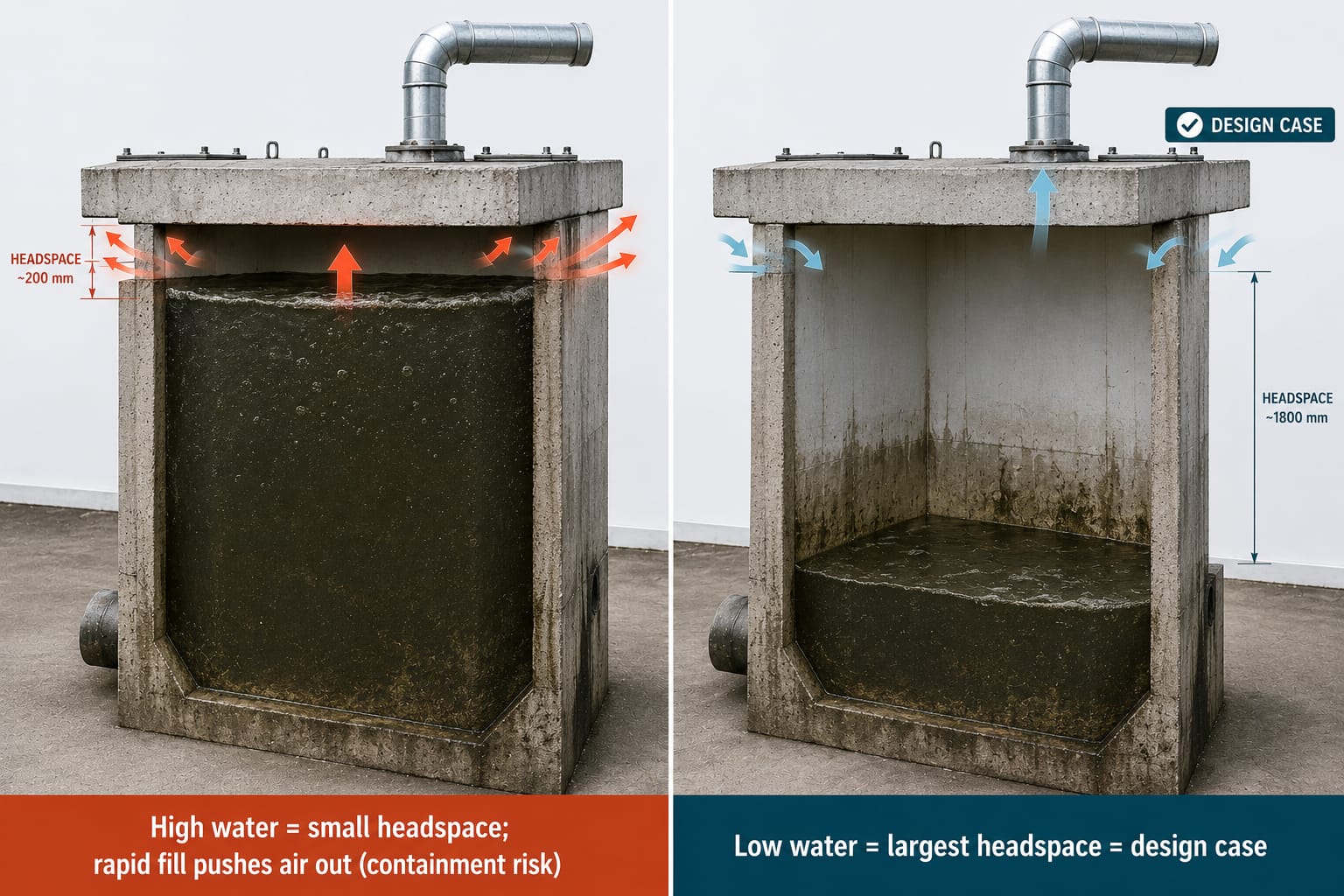
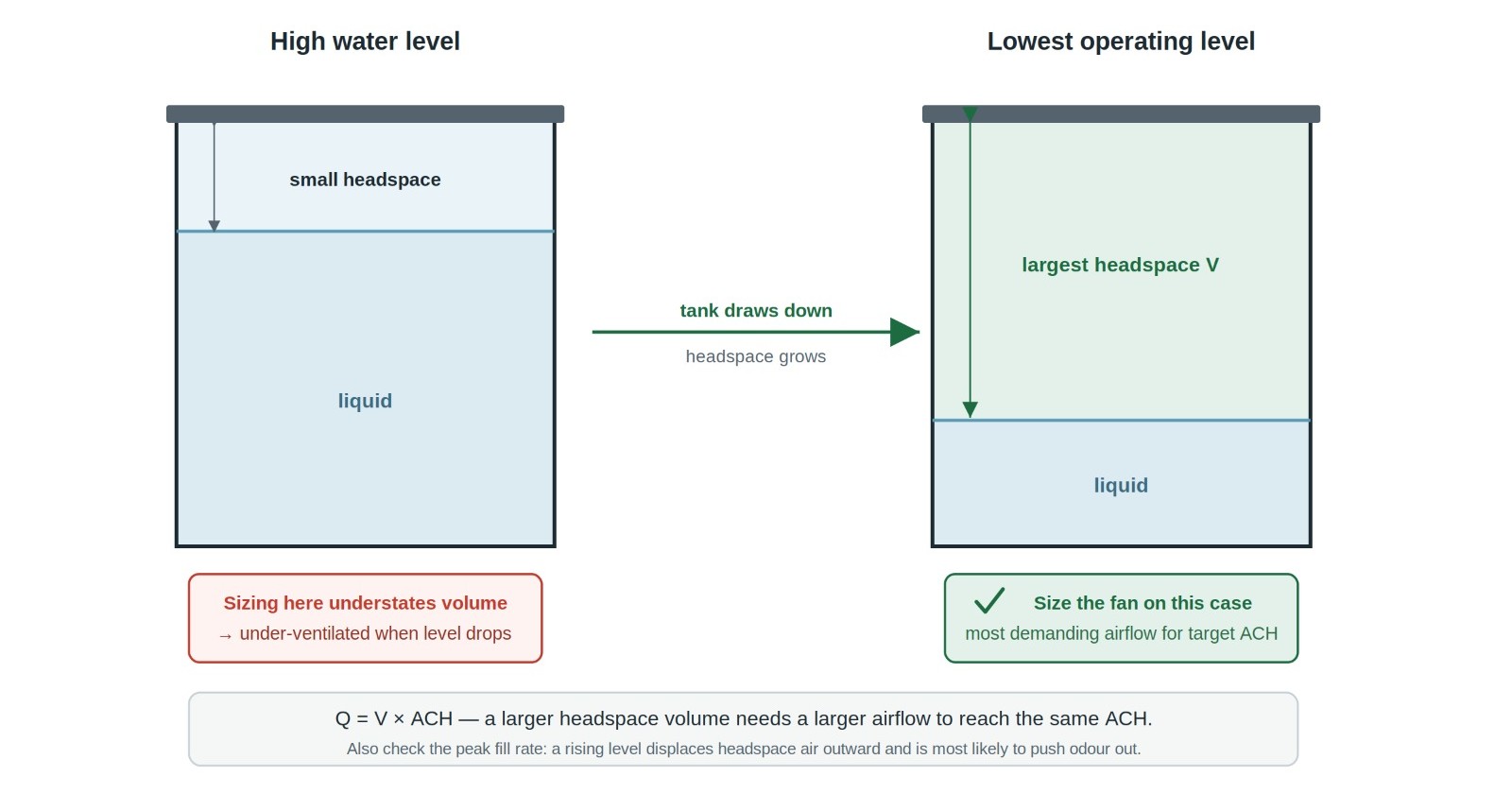
For a covered tank, the air volume used in the ACH calculation is the headspace — the gap between the liquid surface and the underside of the cover. For tanks with a fluctuating level, such as wet wells, balancing tanks and equalisation tanks, the headspace volume should be calculated at the lowest operating liquid level, because that produces the largest air volume and therefore the most demanding airflow case for a given ACH. Sizing on the high-water (small headspace) case would under-ventilate the enclosure whenever the tank draws down and the headspace grows. Note also that the moment most likely to push odour out through cover joints is rapid filling — a rising liquid level displaces headspace air outward faster than the fan can extract it — so the extraction system and its controls should be checked against the maximum fill rate as well as the maximum headspace volume.
2.4 The risk and consequence of an odour escape
An STP located deep inside an industrial estate has a very different tolerance for fugitive odour than one whose boundary wall is shared with housing, a school or a hospital. Where sensitive receptors are close, designers raise the ACH to guarantee a stronger, more reliable negative pressure inside the enclosures so that air is always drawn inward and never pushed out.
2.5 Whether or not people enter the space
This last factor is so important, and so often misunderstood, that the remainder of this guide is largely devoted to it. The air change rate appropriate for a sealed, unmanned covered tank is fundamentally different from the rate required for a building that operators walk into — because the moment a human being enters the space, the purpose of ventilation changes from odour capture to life safety.
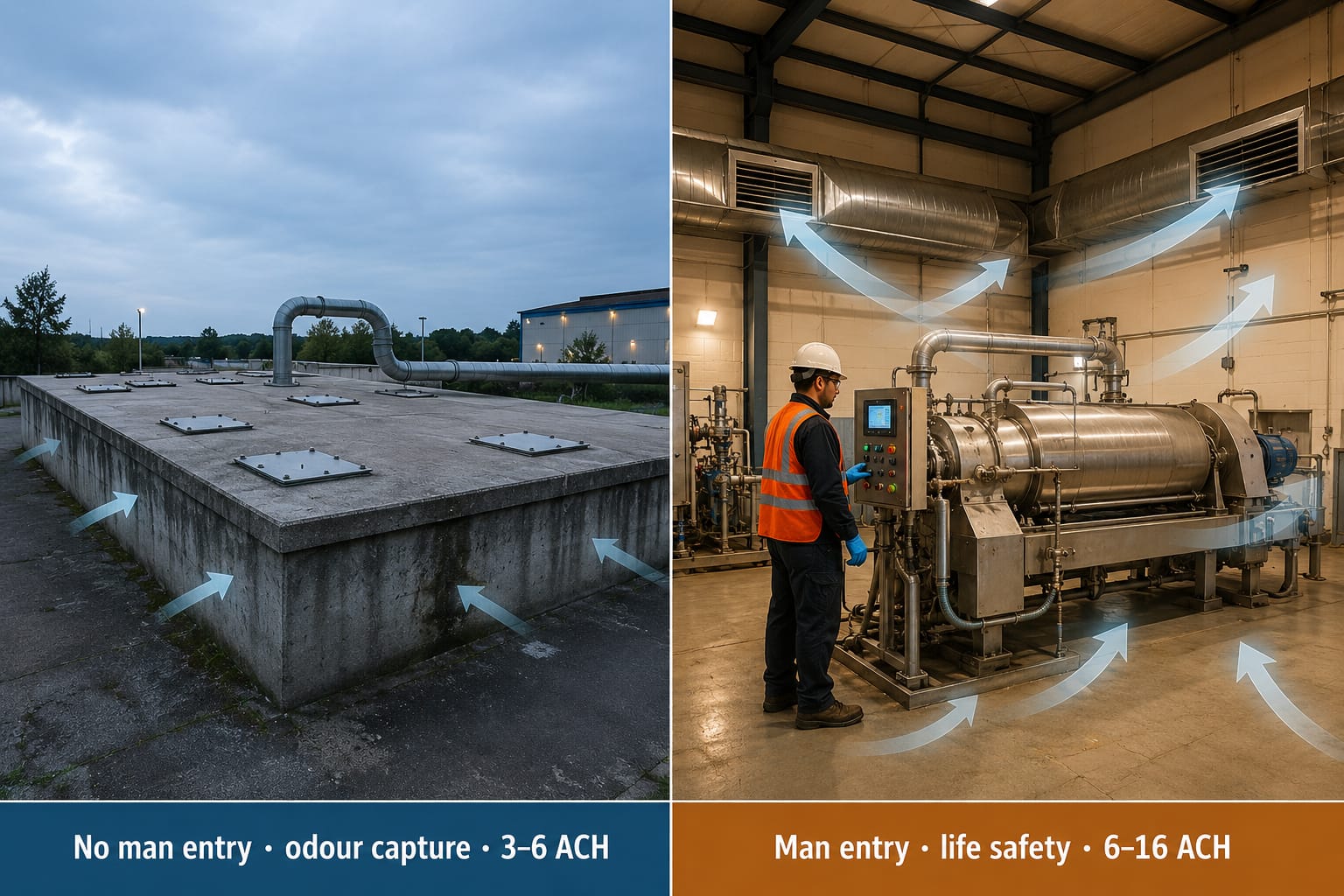
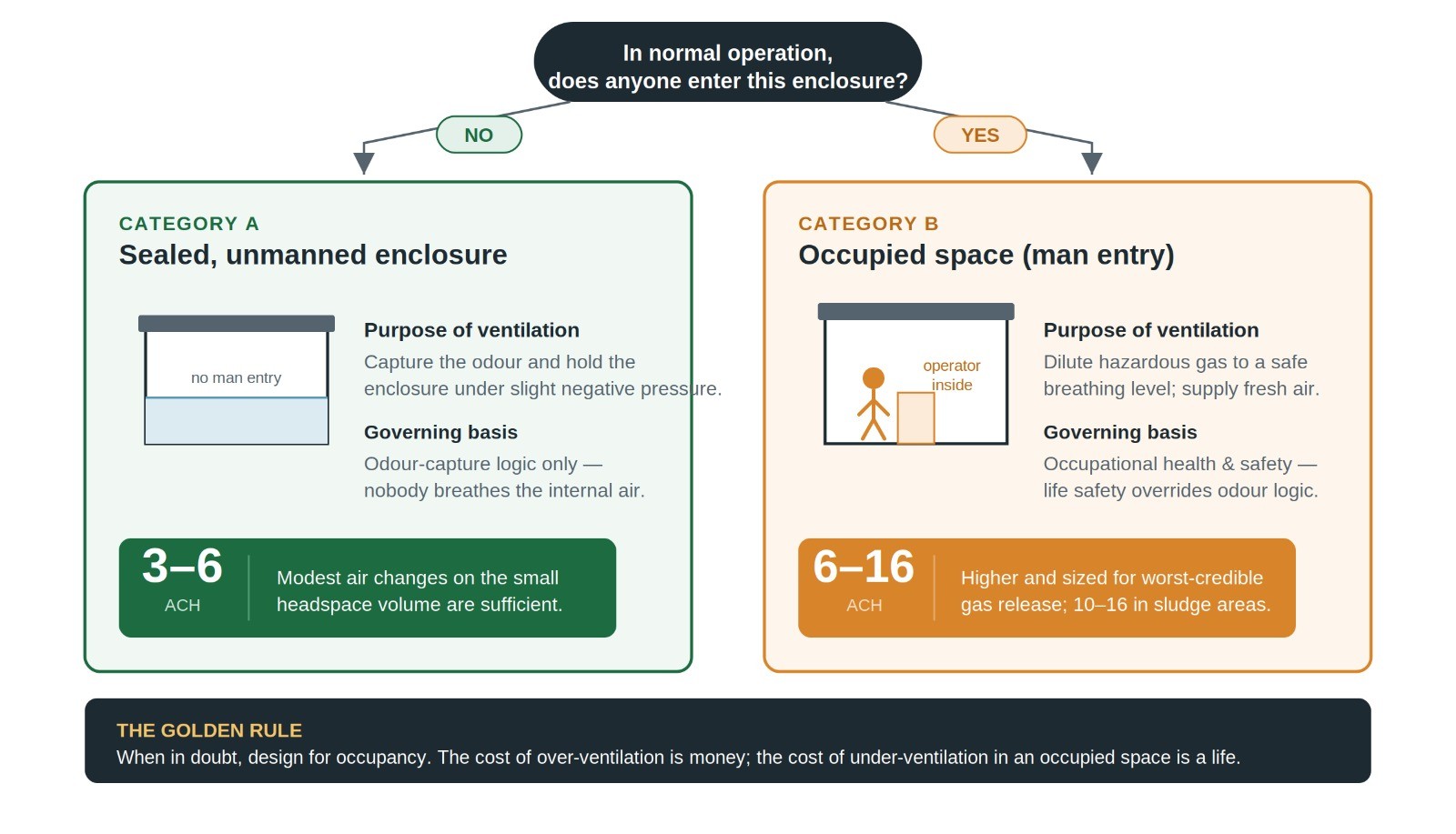
Every enclosed odour source at an STP falls into one of two categories, and the design philosophy for each is genuinely different.
Category A — Sealed, unmanned enclosures (no man entry)
These are spaces that, in normal operation, no person ever enters: a covered grit channel, a sealed primary clarifier, a fully ducted screen chamber, the headspace plenum above a covered balancing tank. The cover is a permanent barrier. The only reason to move air through this space is to capture the odour and hold the enclosure under slight negative pressure so that foul gas flows toward the treatment unit instead of leaking out.
Here, the ACH is governed purely by odour-capture logic: the headspace is small, so even a modest airflow produces a high number of air changes. Typical municipal practice for sealed covered structures sits in the range of 3 to 6 air changes per hour applied to the headspace volume — sometimes expressed instead as an extraction rate per unit of covered liquid surface area. The objective is a stable inward velocity through every gap and joint, usually a face velocity of around 0.5 to 1.0 m/s through any open hatch, with no requirement whatsoever to make the internal atmosphere safe to breathe, because nobody breathes it. Treat the 3–6 range as a starting floor, not a finished answer. On any structure with imperfect covers or many joints, containment is actually decided by the indraft velocity through the openings (0.5–1.0 m/s), and the treatment unit is sized by the mass of H₂S and odour captured — so cross-check the chosen ACH against both, and raise it where either governs.
Category B — Occupied spaces (man entry occurs)
These are buildings and rooms that operators routinely enter: a sludge dewatering building, a centrifuge or filter-press hall, an enclosed screening building, a pump room, and a covered channel large enough to require periodic internal inspection. The instant a person can enter, ventilation acquires a second and overriding job: it must dilute hazardous gases to a safe breathing concentration and supply enough fresh air for the people inside.
This completely changes the basis of design. The ACH is no longer set by odour capture alone — it is set by occupational health and safety, and the governing rate is almost always much higher. For occupied spaces in an STP, design air change rates commonly fall in the range of 6 to 12 ACH, and frequently 10 to 16 ACH or more in rooms with strong emission sources such as sludge dewatering halls. The ventilation must be sized for the worst-credible gas release while a worker is present, not for the average odour load.
THE GOLDEN RULE
If no one enters the space, ventilation exists to capture odour — a modest ACH (typically 3–6) is sufficient.
If a person can enter the space, ventilation exists to protect human life — a much higher ACH (typically 6–12+, often 10–16 for sludge areas) is mandatory.
When in doubt, design for occupancy. The cost of over-ventilation is money; the cost of under-ventilation in an occupied space is a life.
It is worth being explicit about why the presence of a person changes the numbers so dramatically. Three safety-driven requirements come into play the moment a space becomes occupiable.
4.1 Hydrogen sulphide is acutely dangerous
H₂S is not merely an odour nuisance — it is a fast-acting toxic gas. It is detectable by smell at extremely low concentrations, but at higher concentrations it paradoxically deadens the sense of smell, removing the very warning a worker relies on. Occupational exposure limits are measured in single-digit parts per million for an eight-hour shift, with short-term limits only modestly higher. An enclosed STP space with septic sewage can generate H₂S well above these limits. The ventilation system must therefore move enough air to keep the worker’s breathing zone safely below the exposure limit, continuously, and that demands a high air change rate.
4.2 Oxygen depletion and confined-space risk
Many occupied STP odour spaces — deep channels, pump dry wells, sludge rooms — also meet the definition of a confined space. Biological activity and heavier-than-air gases can displace oxygen, creating an atmosphere that is dangerous regardless of odour. A robust air change rate ensures the space is continuously flushed with fresh, oxygen-rich air, and is a core part of any safe system of work for entry. Ventilation is necessary but not sufficient on its own: a permit-required confined space stays a confined space regardless of installed airflow. Atmospheric testing before and during entry, a written permit, gas monitoring of the worker, and a documented rescue plan remain mandatory. The air change rate supports a safe system of work; it does not replace one.
4.3 Fresh-air supply for the occupants themselves
Beyond diluting contaminants, ventilation codes require a minimum quantity of outdoor air per person for any occupied workspace. In an STP building, the occupancy-based fresh-air requirement and the contaminant-dilution requirement are assessed together, and the design ACH is set by whichever is greater — in practice, almost always the contaminant-dilution case.
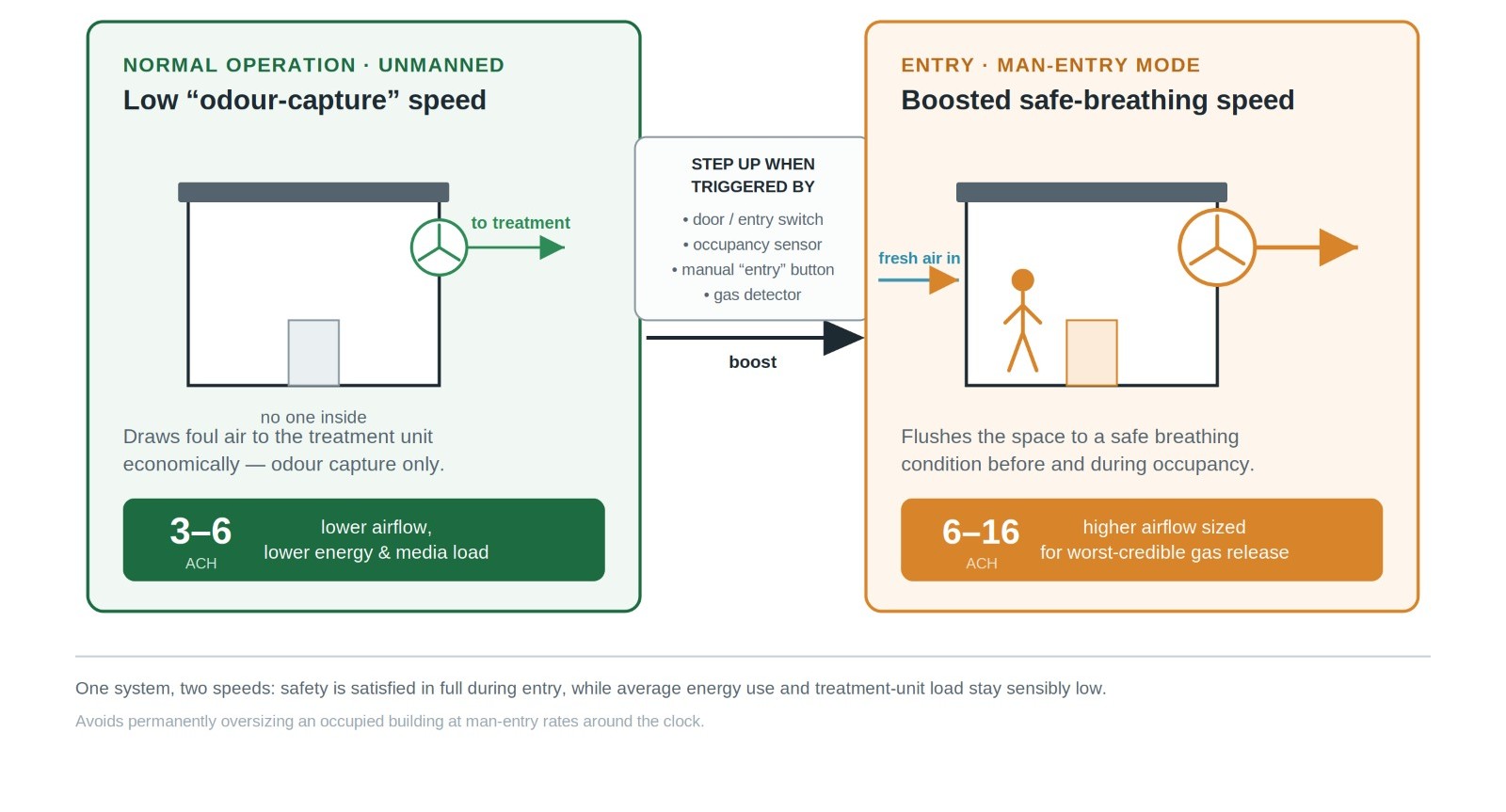
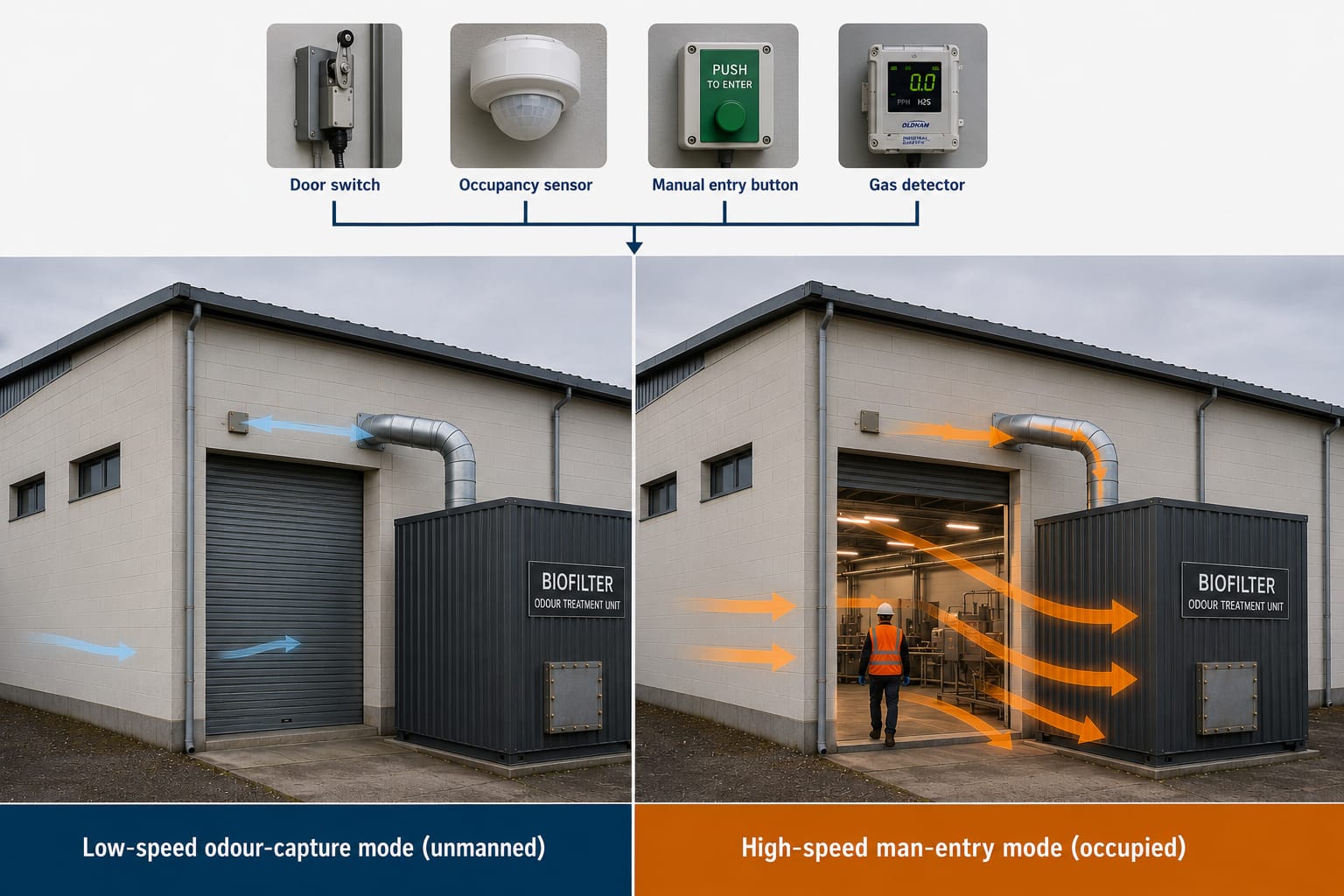
A practical consequence: dual-mode ventilation. Many well-designed municipal STP buildings use a two-speed or variable-speed ventilation strategy. During normal unmanned operation, the system runs at a lower “odour-capture” rate, drawing foul air to the treatment unit economically. When the building is entered — triggered by a door switch, an occupancy sensor, a manual “entry” button, or a gas detector — the system steps up to the higher “man-entry” rate, flushing the space to a safe breathing condition before and during occupancy. This approach satisfies safety in full while keeping the average energy consumption and the load on the odour treatment unit sensibly low.
The table below summarises air change rates widely used in municipal STP odour control practice. They are indicative starting points for preliminary design. The binding figures are always those specified by the relevant authority — the local Urban Local Body, the State Pollution Control Board, the CPCB, or the project’s particular tender specification — and those must take precedence wherever they exist.
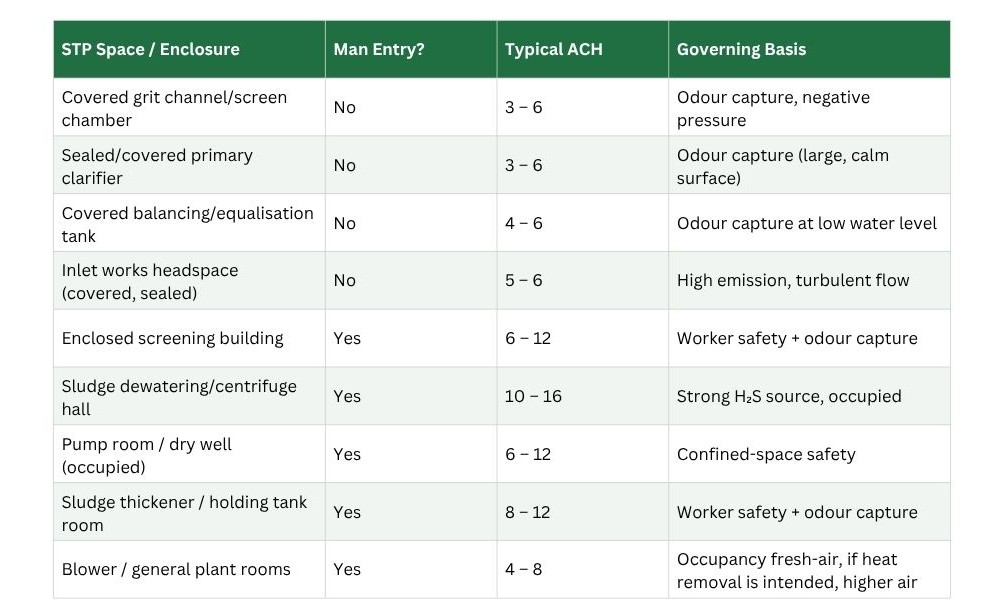
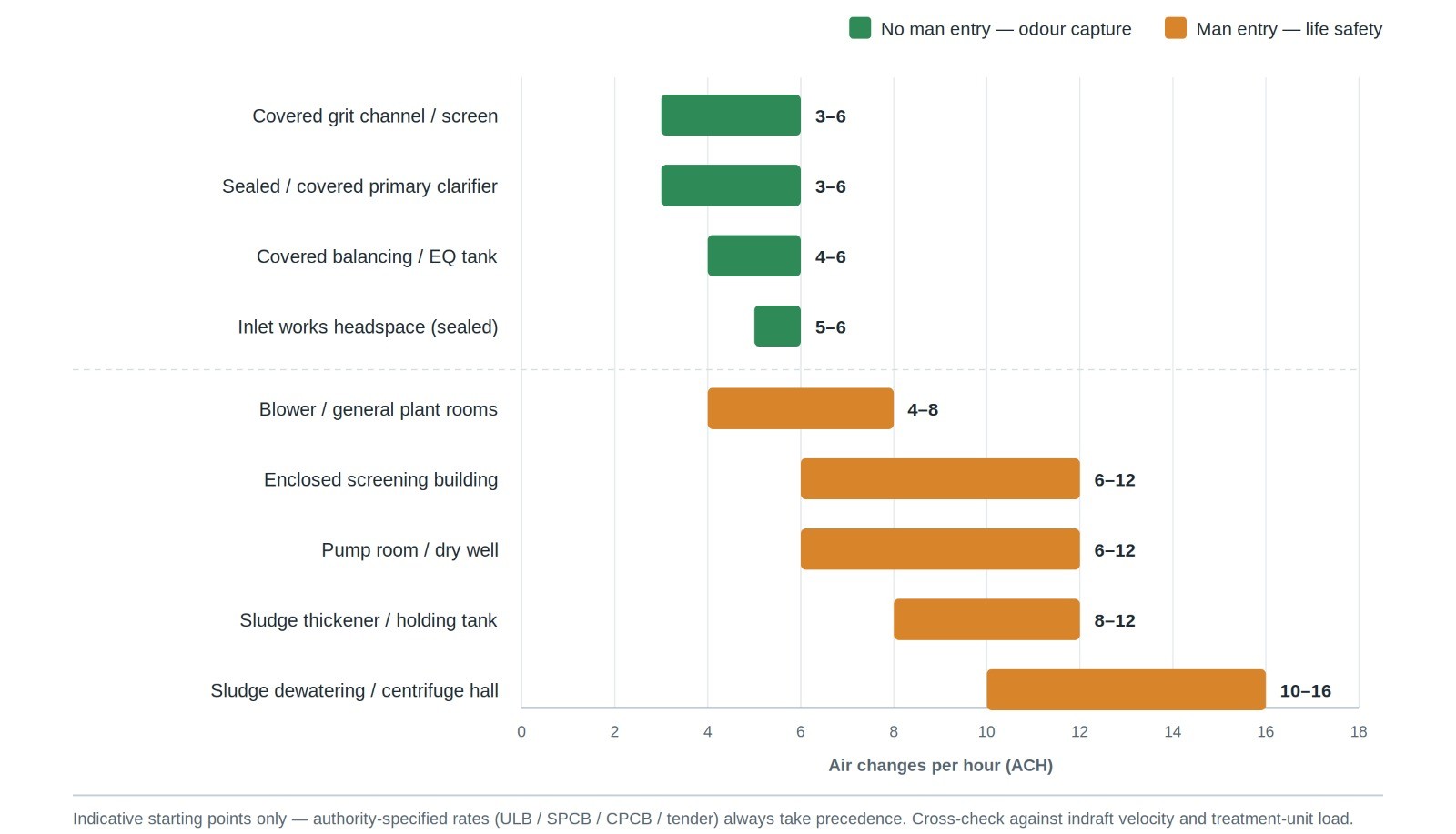
Note: Where an enclosure is normally unmanned but entered occasionally for maintenance, design the permanent system for the odour-capture rate and provide a boosted man-entry mode (portable or fixed) to achieve the higher rate during entry.
Bringing the principles together, the following sequence allows a process engineer to determine a defensible air change rate for any odour source at a municipal STP.
The air change rate is the quiet, decisive number behind every successful odour control system at a municipal STP. Get it right, and the plant runs clean, compliant, safe and economical; get it wrong, and the municipality faces either a stream of public complaints or a permanently inflated energy bill — and, in occupied spaces, a genuine safety hazard.
The single most important discipline is to ask, for every enclosed space, whether a person enters it. Where the answer is no, ventilation serves odour capture, and a modest ACH suffices. Where the answer is yes, ventilation serves human life, and a substantially higher ACH becomes non-negotiable. A thoughtful design recognises this distinction, applies authority-specified rates where they exist, leans on sound engineering judgement where they do not, and uses dual-mode ventilation to reconcile safety with efficiency. That is how the best air change rate — not merely an acceptable one — is determined.
About Elixir Enviro Systems
Elixir Enviro Systems designs and delivers odour control systems — biofilters, bioscrubbers and chemical scrubbers — along with wastewater treatment, anaerobic digestion and onsite odour measurement services for municipal and industrial clients. For support in sizing the air change rate and odour control unit for your STP, contact our technical team at info@elixirenviro.in or visit www.elixirenviro.in.