Activated carbon has long been a cornerstone of industrial odour and gas control — but standard activated carbon has a fundamental limitation. Its mechanism is purely physical: molecules are trapped in microscopic pores through van der Waals forces, which work well for larger, non-polar organic compounds but fail for the gases that cause the most persistent odour problems. Hydrogen sulphide, ammonia, and light mercaptans are small, polar molecules that slip through unimpregnated carbon beds with little resistance.
Impregnated activated carbon solves this by loading reactive chemicals directly into the carbon’s pore structure. When a target molecule enters the bed, it doesn’t just get physically trapped — it reacts with the impregnant and is chemically converted or bound into a stable, non-volatile compound. This dual action — physical adsorption plus chemisorption — delivers removal capacities that are typically three to ten times higher than unimpregnated carbon for the same contaminants and enables reliable treatment of compounds that plain carbon simply cannot address.
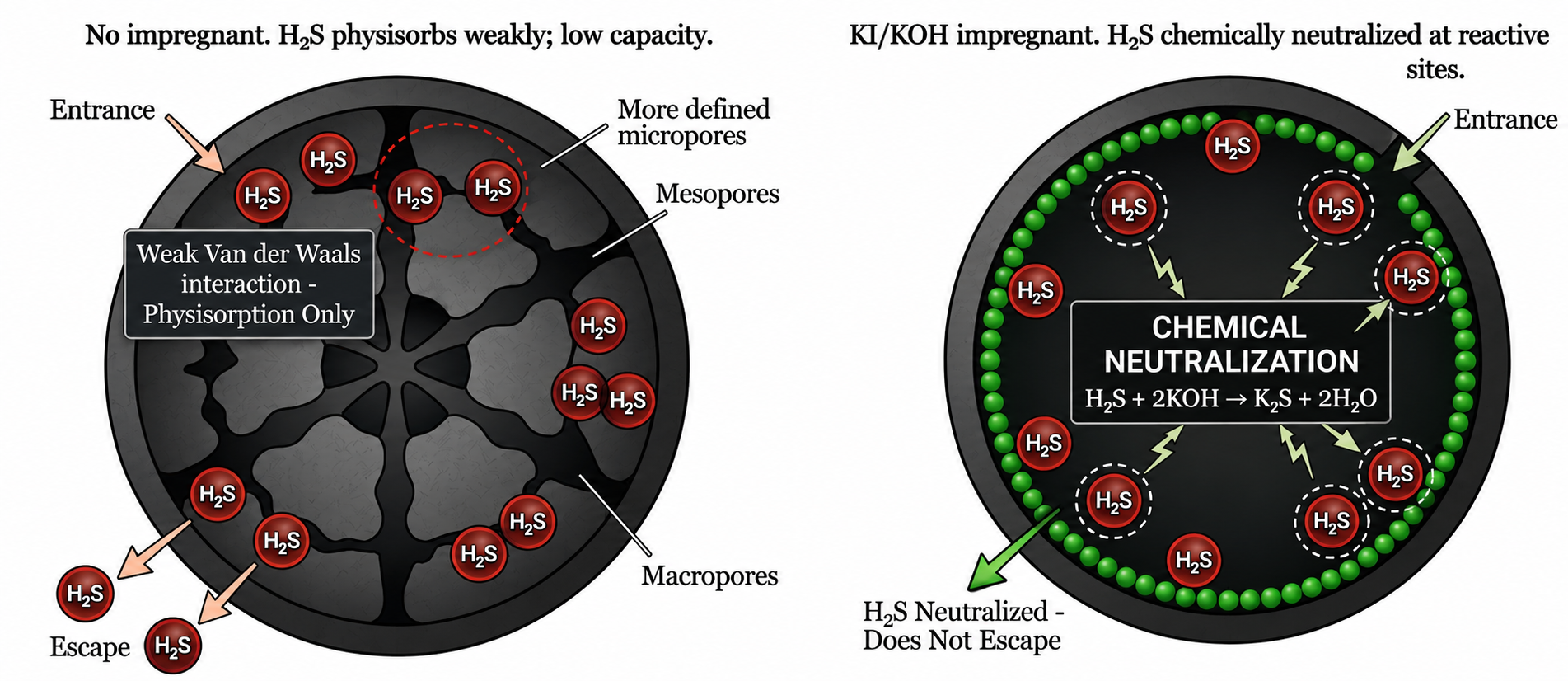
Figure 1: Side-by-side comparison of plane-activated carbon vs impregnated Activated Carbon
The challenge is that no single impregnant handles every gas. KOH carbon that excels at H₂S removal is the wrong choice for an ammonia-dominated stream. Phosphoric acid carbon, which neutralises amines efficiently, offers no benefit against acid gases. Specifying the wrong type doesn’t just underperform — it can exhaust the bed in a fraction of the expected service life, creating unplanned maintenance costs and odour breakthroughs.
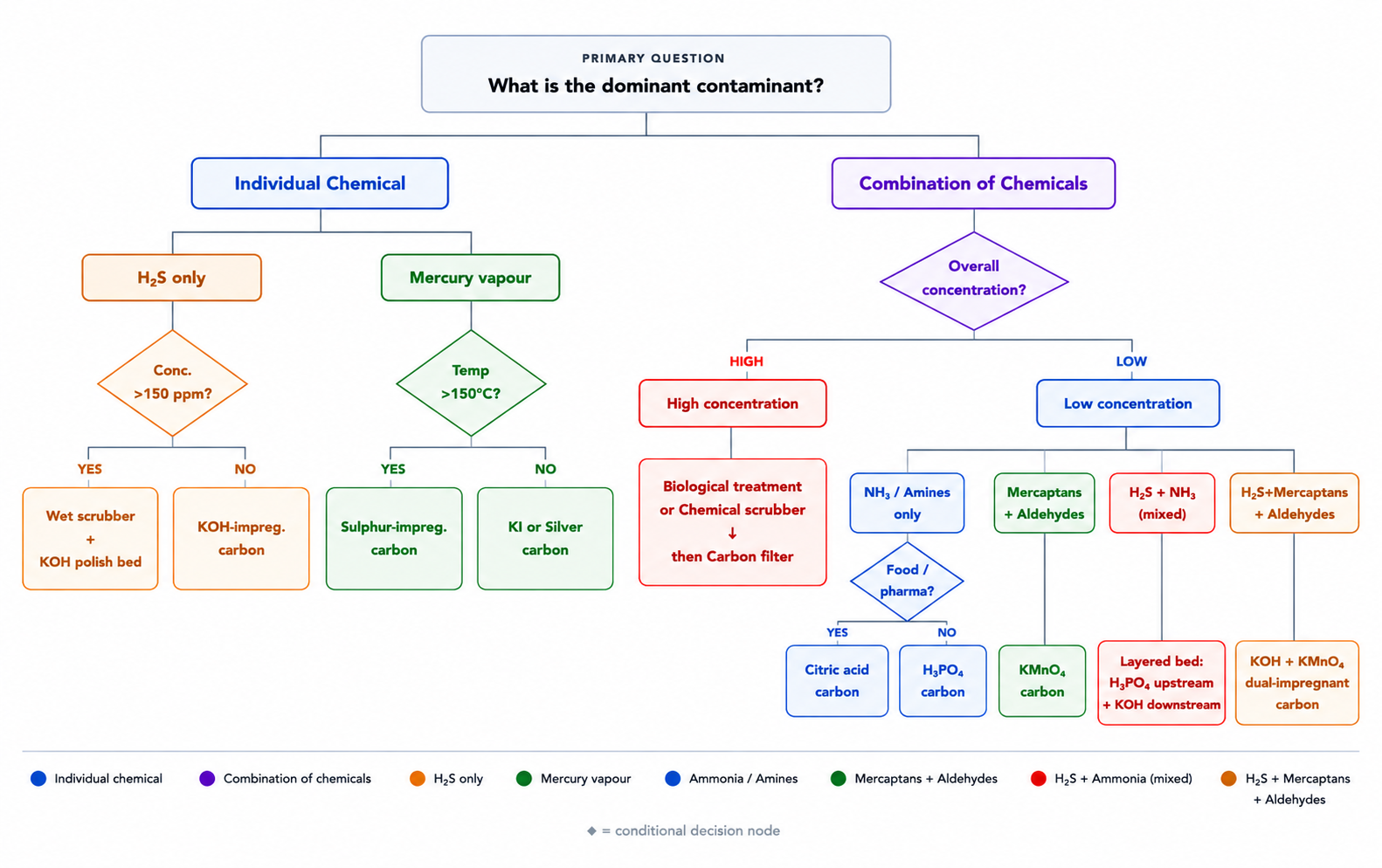
This guide covers the full range of commercially available impregnated activated carbons — their chemistry, target compounds, capacities, and limitations — to help engineers and plant operators specify the right product for each application.
1.1 Potassium Hydroxide (KOH) Impregnated Carbon
KOH impregnation is the dominant type used for industrial odour control — the industry standard specification for H₂S removal from closed sewer headworks, pump stations, and wastewater treatment facilities.
In an oxygen environment, partial self-regeneration of KOH happens, which improves bed life.
1.2 Sodium Hydroxide (NaOH) Impregnated Carbon
NaOH impregnation provides the same neutralisation of acid gases as KOH but at a lower cost. Used for the same compound classes — H₂S, HCl, HF, SO₂ — where less premium performance is acceptable.
2.1 Potassium Permanganate (KMnO₄) Impregnated Carbon
KMnO₄ impregnation oxidises target molecules on the carbon surface — a completely different approach from the acid-base neutralisation of KOH/NaOH carbons. As a strong oxidant, KMnO₄ reacts directly with reduced sulphur compounds and aldehydes, converting them to odourless oxidation products.
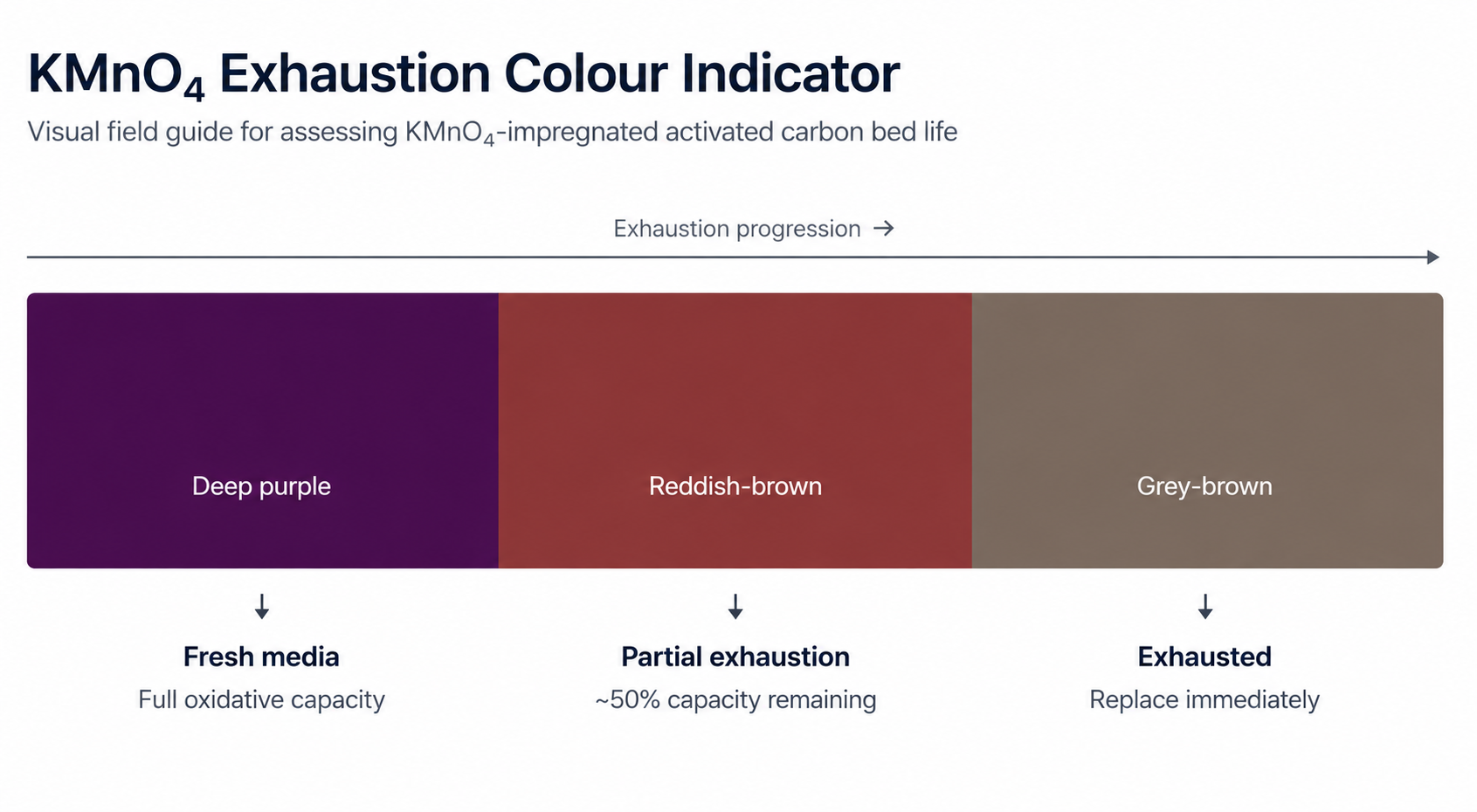
Figure 1: illustration of visual colour indication of exhaustion of KMnO4 impregnated carbon
3.1 Phosphoric Acid (H₃PO₄) Impregnated Carbon
Phosphoric acid impregnation is the most widely used impregnation for ammonia and amine removal — compounds that plain activated carbon handles very poorly. The acid on the carbon neutralises the basic ammonia molecule to form a very stable ammonium phosphate salt.
3.2 Citric Acid Impregnated Carbon
Citric acid impregnation gives the same ammonia-neutralisation mechanism as phosphoric acid, but using food-grade citric acid — appropriate for food and pharmaceutical manufacturing environments where phosphate contamination risk must be minimised.
3.3 Sulphuric Acid (H₂SO₄) Impregnated Carbon
Sulphuric acid impregnation is the most aggressive acid-treated carbon available, offering very high capacity for ammonia and amine removal. Its highly corrosive nature limits use to robust industrial environments.
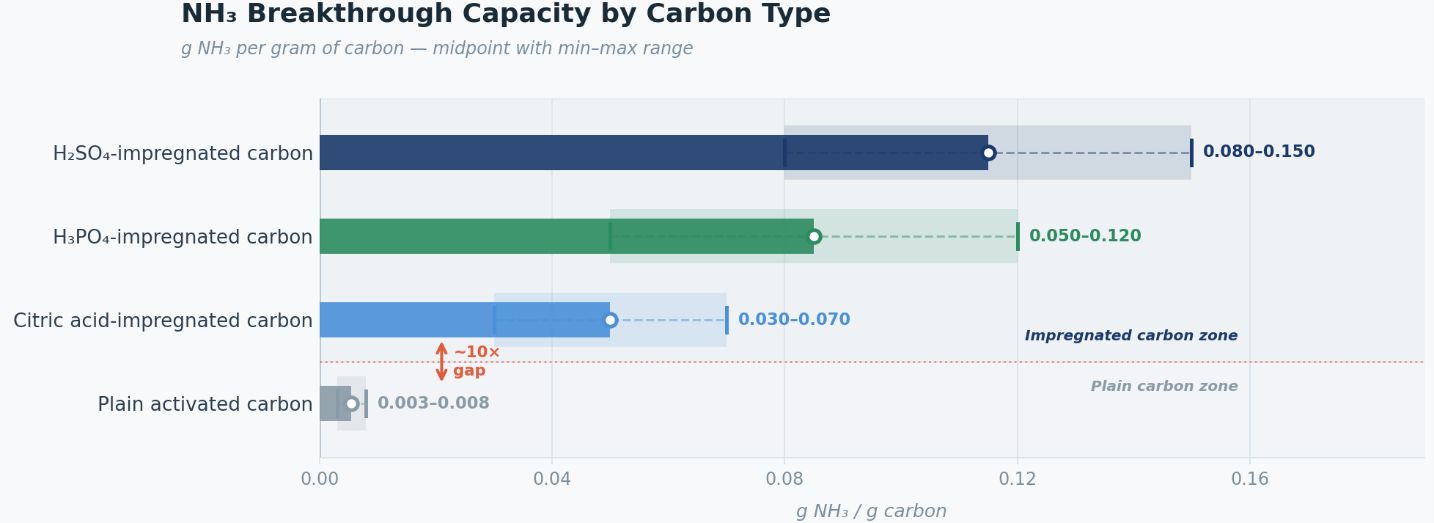
Figure 2: illustration of plain carbon vs impregnated Carbon for NH3 removal. For demonstration purposes only, actual may differ from the supplier
4.1 KOH + KMnO₄ Dual-Impregnated Carbon
The combination of alkaline and oxidant impregnation in one carbon product provides a broad-spectrum medium. H₂S is addressed by both KOH neutralisation and KMnO₄ oxidation; aldehydes are addressed by KMnO₄; further acid gases by KOH.
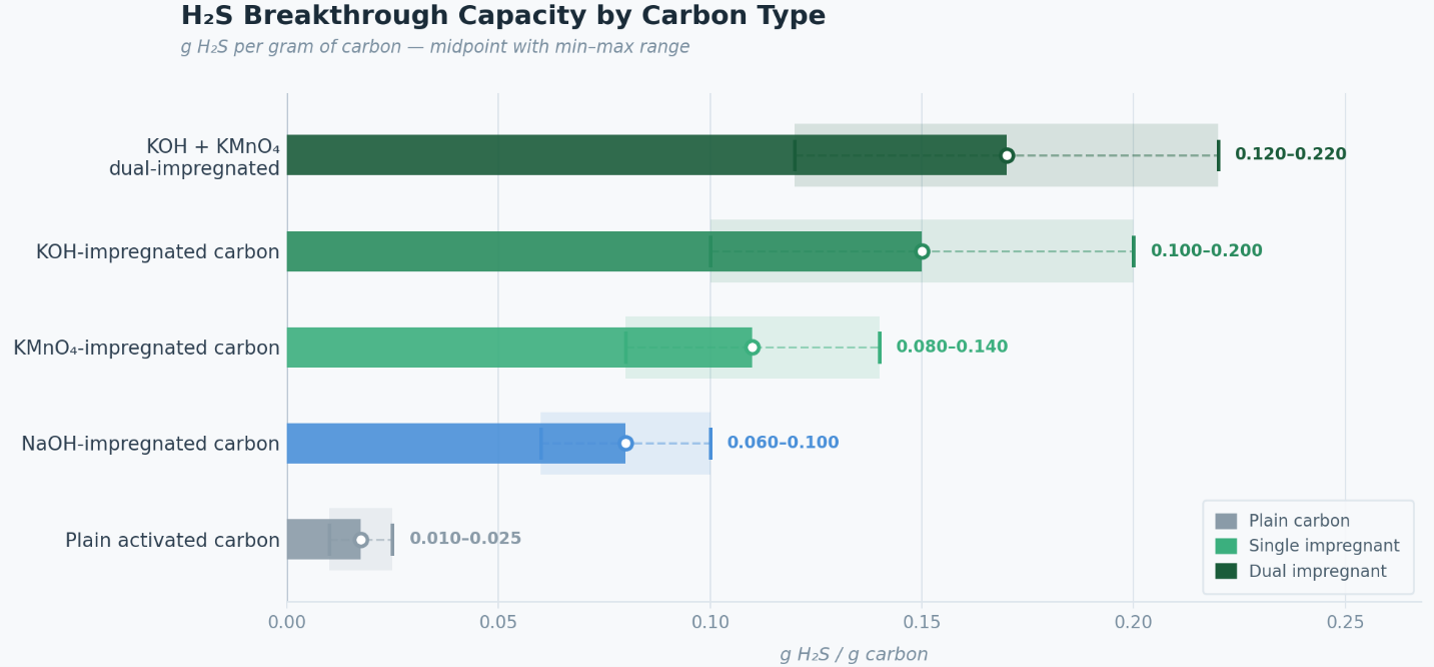
Figure 3: illustration of dual impregnated Carbon for H2S removal. For demonstration purposes only, actual may differ from the supplier
4.2 Acid + Alkali Layered Bed Systems
A series of separate bed layers: acid-impregnated carbon (first layer — ammonia and organic amines) followed by alkali-impregnated carbon (second layer — H₂S and acid gases). This offers advantages when the stream has both significant ammonia and H₂S, where a single impregnant would reduce capacity for both.
Frequently Asked Questions
Q: Can activated carbon remove hydrogen sulphide (H₂S) effectively?
The capacity of plain activated carbon for H₂S is only limited and temporary due to the catalytic oxidation reaction being quickly inhibited by the deposition of elemental sulphur in the pores. Consistent removal requires KOH-impregnated, NaOH-impregnated, or KMnO₄-impregnated carbon. Such impregnated grades perform vastly better than unimpregnated carbon and are the correct specification for any sewage or industrial H₂S control application.
Q: Is activated carbon effective for ammonia removal from air?
No — plain activated carbon has very poor affinity for adsorption of ammonia due to the molecules being too small and polar for effective physisorption. A large-capacity application will require a wet acid scrubber; a small or low-to-medium ammonia stream requires phosphoric acid (H₃PO₄) or citric acid-impregnated activated carbon. Specifying unimpregnated carbon for an ammonia-dominated stream is a common and expensive error.
Q: I know I have an odour problem, but I’m not sure which gases are present. Where do I start?
Specifying the wrong carbon type is one of the most common and costly errors in odour control system design — a KOH carbon bed will exhaust in days if ammonia is the dominant compound, not H₂S. Before specifying any carbon type, the inlet stream should be characterised: at a minimum, H₂S and ammonia concentrations, airflow rate, and relative humidity. If the odour source is complex (rendering, composting, mixed wastewater), a broader VOC scan is worthwhile. Elixir can advise on sampling approach and help interpret results before any equipment is specified.
Q: Is impregnated activated carbon always the right choice for H₂S and ammonia odour control?
Not always — and getting this wrong is an expensive mistake. Impregnated carbon is the right choice when you need:
However, for applications with consistently high H₂S loads (above 200–500 ppm), large air volumes, or where long-term operating cost matters more than capital cost, a biological treatment system — such as a biofilter or biotrickling filter — is often significantly more economical. Biological systems consume no chemical reagents, produce no chemical waste stream, and can handle high-concentration sulphide and ammonia streams at a fraction of the carbon replacement cost over a 5–10-year horizon.
The right answer depends on your specific concentrations, flow rates, space constraints, and operational model. Elixir Enviro System designs both activated carbon systems and biological odour treatment systems — contact us to evaluate which approach makes sense for your site.
Q: How often will I need to replace the carbon, and what does that cost over time?
Replacement frequency depends on inlet concentration, airflow rate, and bed volume, and the numbers vary widely. A small lift station handling 5 ppm H₂S at low flow might see bed life of 12–18 months. A high-flow headworks at 50 ppm might need quarterly replacement. For higher-load applications, the annual carbon replacement cost can exceed the capital cost of the original system within 2–3 years — at that point, a biological system warrants serious evaluation. We can model both scenarios for your specific site so you can make the decision based on the total cost of ownership, not just the upfront price.
Q: What happens if I specify the wrong type of impregnated carbon?
The bed exhausts faster than expected, a breakthrough occurs, the odour problem returns, and the carbon has to be replaced early — none of which was in the budget. The most common errors are: using plain carbon for H₂S or ammonia (where impregnated carbon is essential), specifying KOH carbon for an ammonia-dominated stream, and using a single-impregnant carbon for a mixed stream that needs a layered system. These aren’t hypothetical — they’re the most frequent reasons clients come to us after a disappointing first installation with another supplier.
Q: My wastewater treatment plant has both H₂S and ammonia in the ventilation air. What type of carbon should I use?
A mixed H₂S and ammonia stream is one of the most common — and most commonly misspecified — scenarios in wastewater odour control. A single impregnant cannot address both effectively: alkali carbons (KOH, NaOH) that neutralise H₂S will be partially consumed by ammonia, reducing their capacity for the primary target; acid carbons (H₃PO₄) that neutralise ammonia offer no benefit for H₂S.
The correct specification is a sequential system: an H₃PO₄-impregnated carbon layer upstream to remove ammonia first, followed by a KOH-impregnated carbon layer downstream for H₂S removal. This sequential arrangement protects each impregnant from the competing compound, maximising the effective capacity of both layers. Typical layer volume ratios are 1:2 to 1:3 (acid: alkali) depending on the relative concentrations of each compound in the inlet stream.
Q: My stream contains H₂S and mercaptans together. Which carbon type should I choose?
KOH-impregnated carbon will address H₂S and low-molecular-weight mercaptans (methyl mercaptan at low concentrations), but its performance against dimethyl sulphide, dimethyl disulphide, and higher mercaptans is limited. KMnO₄-impregnated carbon handles mercaptans more effectively through oxidative destruction but is more expensive per unit volume.
Where both H₂S and mercaptans are significant, KOH + KMnO₄ dual-impregnated carbon is the most effective single-medium solution. If the stream also contains aldehydes — common in rendering and food processing exhausts — the dual-impregnant type is strongly preferred, as KMnO₄ alone addresses aldehydes while KOH does not.
Q: At what inlet H₂S concentration should I switch from KOH carbon to a wet chemical scrubber?
Impregnated carbon is cost-effective and practical for H₂S inlet concentrations up to approximately 150–200 ppm, depending on flow rate, required outlet specification, and bed volume economics. Above this range, the volume of carbon required, and the frequency of replacement typically make a wet caustic scrubber (NaOH dosing) more economical as the primary treatment stage, with a KOH carbon polishing bed downstream to achieve ppb-level outlet concentrations.
For applications requiring outlet concentrations below 1 ppm (e.g., enclosed work areas, sensitive processes), KOH-impregnated carbon is almost always specified as the final polishing stage regardless of what upstream treatment is used.
Impregnated activated carbon is a precise tool — highly effective when correctly specified, costly when it isn’t. The chemistry is well understood; the challenge is matching the right impregnant to your specific stream. If you’re designing a new odour control system or troubleshooting an underperforming one, Elixir‘s team can help you get the specification right the first time — whether that means an impregnated carbon system, a biological treatment solution, or a combination of both.
Get in touch: info@elixirenviro.in | +91 9995 821 471 | www.elixirenviro.in